for a piano prepared using electronics
Written for and dedicated to Judith Wegmann
Download Score with Notation
Notation clarifications:
G = G natural (German “g”)
D = D natural (German “d”)
B♭ = B flat (German “B”)
B = B natural (German “H”)
Any reference to “string” (e.g., D string) refers to the corresponding piano string.
In the first section, the dyads are chosen so that the first-order difference tone — that is, the difference between the fundamental frequencies of the two notes played — falls on a D. Due to the piano’s tuning system, however, the frequency of the sounding D always deviates by a few hertz from the “tuned” D. This deviating frequency is transmitted as an electric voltage through the freely vibrating D string of the piano. The current flowing through the string generates a magnetic field. A magnet placed around the D string interacts with this field, causing the string to vibrate. If the frequency deviates too far, the vibration is dampened. The closer the match of frequencies, the stronger the vibration is reinforced. Beat phenomena arise between the electrical voltage and the fundamental frequency of the string, which in turn interact sonically with the played dyad.
Through the changing string tension and the varying electrical voltage, microtonal shifts and glissandi can occur. The effects depend on the room, humidity, number of people present, the piano’s tuning, and so forth. Under certain circumstances, the effects may be inaudible; on some days, they can become quite pronounced. The relatively long intervals between dyads give the system the opportunity to unfold. A prepared string can slowly be set into vibration; an overtone rises or falls until a beat pattern stabilises.
The intervals in the first section are arranged so that with each new dyad, the deviation of the difference tone from the D string decreases, and the string vibrates increasingly in sympathy.
In the second section, the sequence of dyads is chosen so that the difference tones alternate between greater and smaller deviations relative to the G string. This means that with every second dyad, the string is charged with a stronger impulse. This, together with the impulse produced by additionally striking the G string, ensures that the string continues to vibrate even when the electrical voltage deviates more significantly from its fundamental frequency. More rising and falling tones are generated, and the interaction between the various sounds becomes increasingly complex.
In the third and final section, the B♭ string is also electrified and equipped with a magnet. As with the D string, but unlike the G string, the B♭ string is neither damped nor additionally struck by hand. The dyads are arranged so that their difference tone always “jumps” from slightly above to slightly below the fundamental frequency of the B♭ string, and vice versa. This “jumping” occurs gradually, in the form of a glissando. Each time, the electrical voltage crosses the frequency of the B♭ string, causing it to be repeatedly set into vibration, damped, and then vibrated again, and so on. In this section, the glissando effects are therefore presented most prominently. The “migration” of the frequencies again determines the timing intervals between dyads.
Setup
To perform the piece as written, a grand piano is required. For an upright piano, the B♭ string should replace the B string, and the frequencies should be adjusted accordingly.
Preparing the strings requires three horseshoe magnets with a holding force of approximately 100–120 N each, gaffer tape to secure the D key, an amplifier with roughly 50 W output, two speaker cables with clips to connect the strings to the amplifier, and a laptop from which sine waves are sent to the amplifier.
A resistor (~2 ohms), matched to the amplifier’s power, should be connected between the string and the amplifier to prevent overheating.
A pedal is needed to control the electronics—for example, a sustain pedal connected via a MIDI keyboard to the laptop. Using software such as Max/MSP, the sine tones are triggered sequentially via the pedal, with each note in the electronics corresponding to the next sine tone being activated by the pedal.
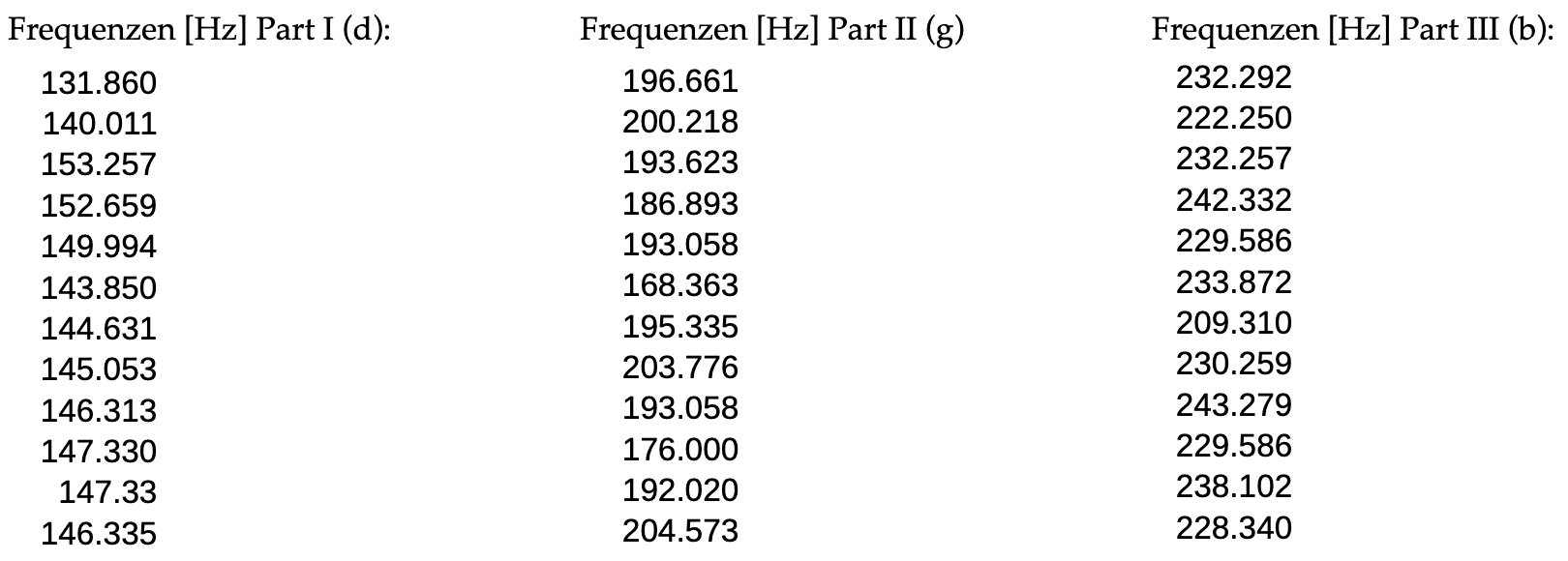
In Parts I and II, the frequencies jump directly to the next frequency when the pedal is pressed. In Part III, the frequencies are intended to glide linearly to the next frequency over seven seconds.
Since the frequencies depend on the tuning of the piano, they must be recalibrated for the instrument each time. To do this, a sine wave corresponding to the fundamental frequency of each of the three strings is first sent—for example, 146.83 Hz for the D string—and a magnet is placed over the undamped string. The frequency is then slowly adjusted upward or downward until the maximum resonance is achieved. Dividing the resulting frequency by the fundamental frequency (146.83 Hz for the D string) gives the ratio by which all frequencies for that string must be multiplied. This procedure is carried out for all three strings. (As a rough starting point, it is best to use a tuner with a frequency display to measure the frequencies of the three strings.)
The volume of the electronics should be as loud as possible, without causing the string’s fundamental frequency to become an overtone, and without producing audible distortion.
Performance Instructions
At the beginning of the piece, the two clips of the speaker cables are attached to the two ends of the D string, behind the bridge, so that the string’s vibration is not affected. Ideally, only one string is used, and neither the other strings of the chord nor the piano frame should be touched.
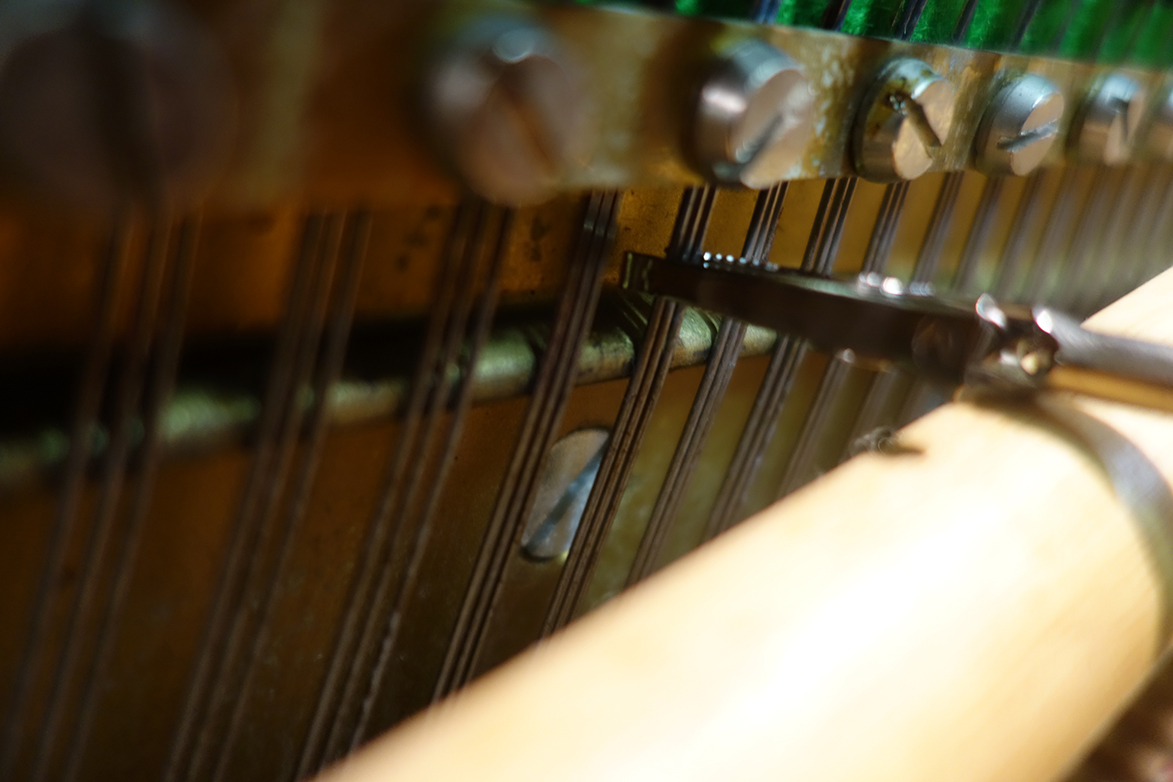
The first horseshoe magnet is then positioned so that the D string passes through the centre of the magnet. The magnet should be placed as close as possible to the midpoint of the string (i.e., half its length). On some grand pianos, this may be difficult; in such cases, the magnet can be placed on the bass string that runs above the D string.
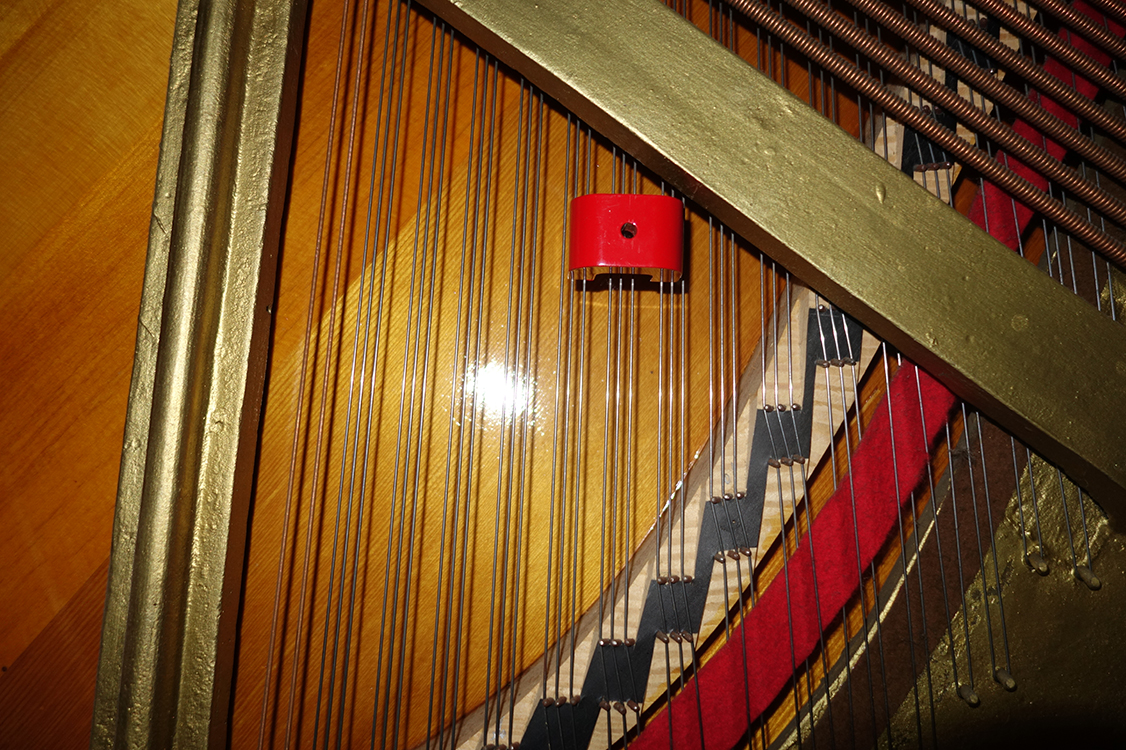
The amplifier is switched on, and the first frequency is sent to the string. When playing the first dyad, the D string is simultaneously depressed without producing a sound and secured so that it remains held down for the duration of the piece. The duration of the dyad is indicated in the score for each bar. The timing should not be measured exactly with a stopwatch.
Notes that are notated across a bar are struck in succession. The dyads should be played very softly, with the higher note always slightly louder than the lower note.
At the end of the first part, the speaker cables are connected to the G string, and the second magnet is placed on the G string (the magnet on the D string remains). Unlike in the first part, the G string is struck each time and damped at the end of the bar. However, the G string should be played as quietly as possible. Ideally, the electronics pedal is pressed just slightly before the G string is struck.
At the end of the second part, the B♭ string is connected, and the third magnet is placed over the B♭ string (the other two magnets remain). The sustain pedal is pressed with the first dyad and held until the end of the piece. The dyads are played forte. Bars in the third part are generally shorter than those in the preceding parts.
Except for the third part, the sustain pedal is not used. In the first and second parts, the sostenuto pedal may be used once per bar, if available.
At the end of the piece, the amplifier is switched off, and the sustain pedal is held until all sounds have fully died away.
Cyrill Lim, 2018 (revised 2019)