Sound installation for five loudspeakers directed by satellite dishes
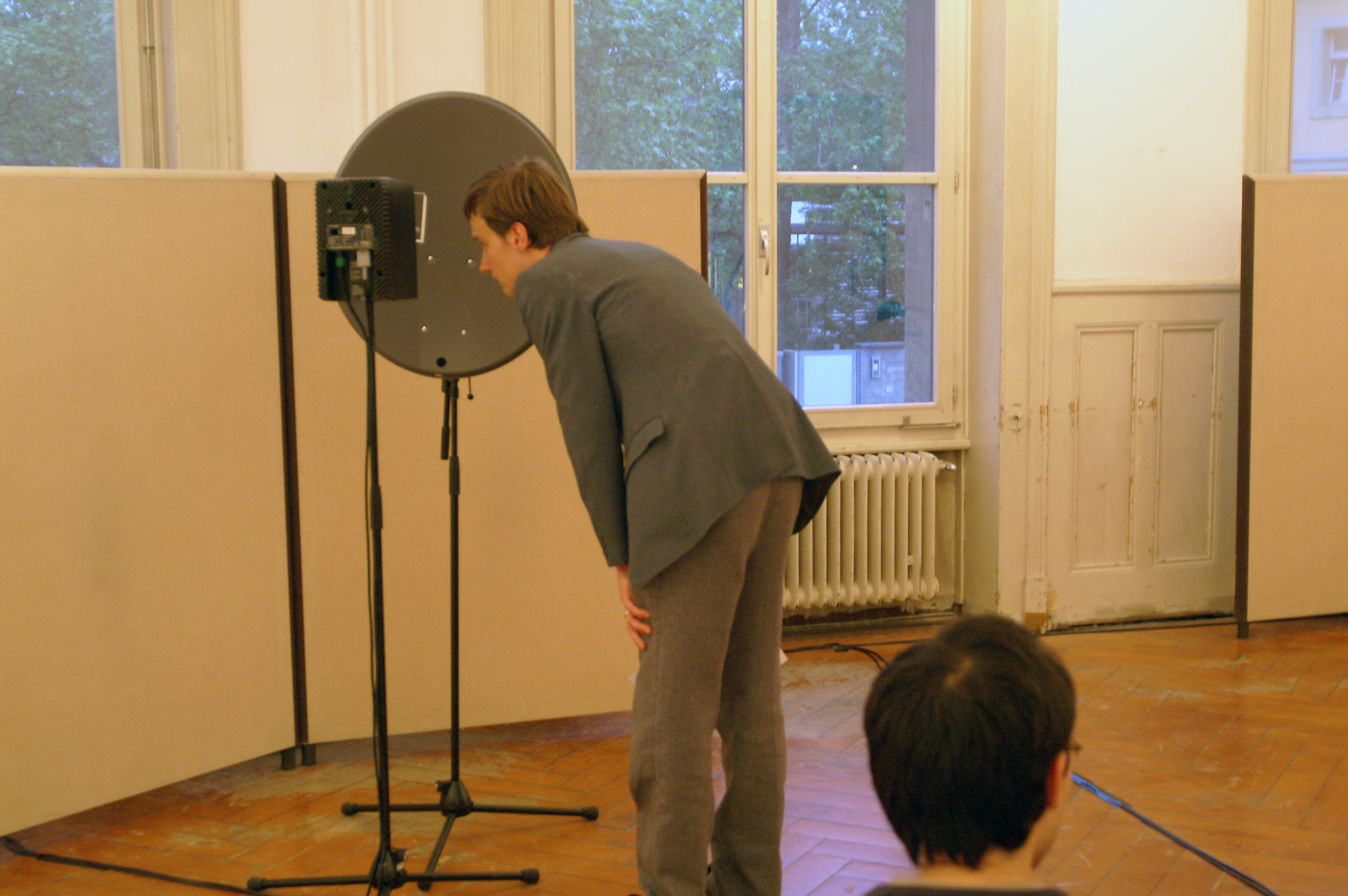
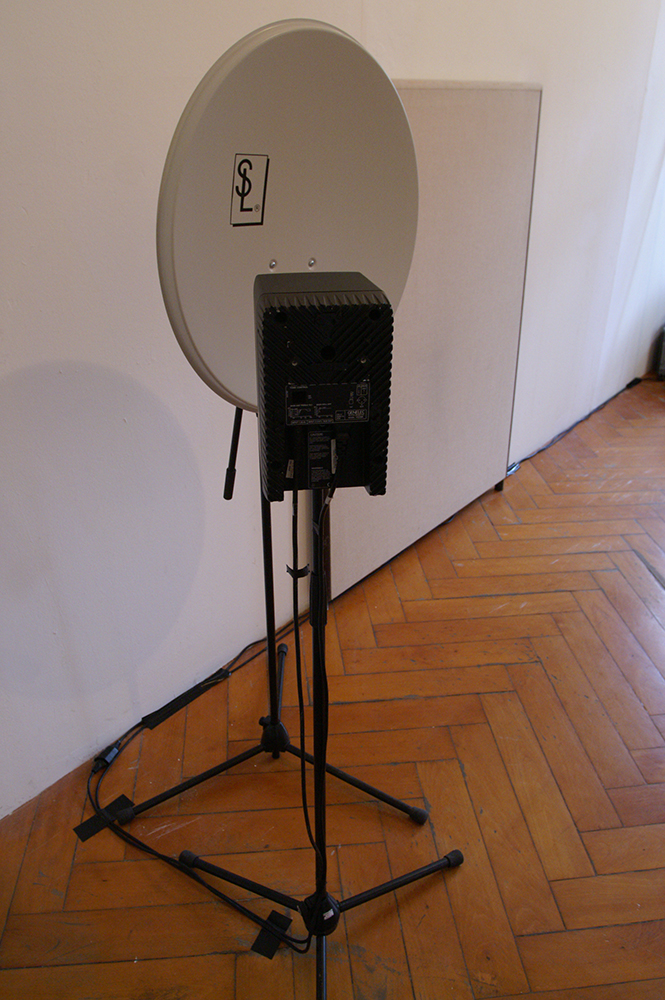
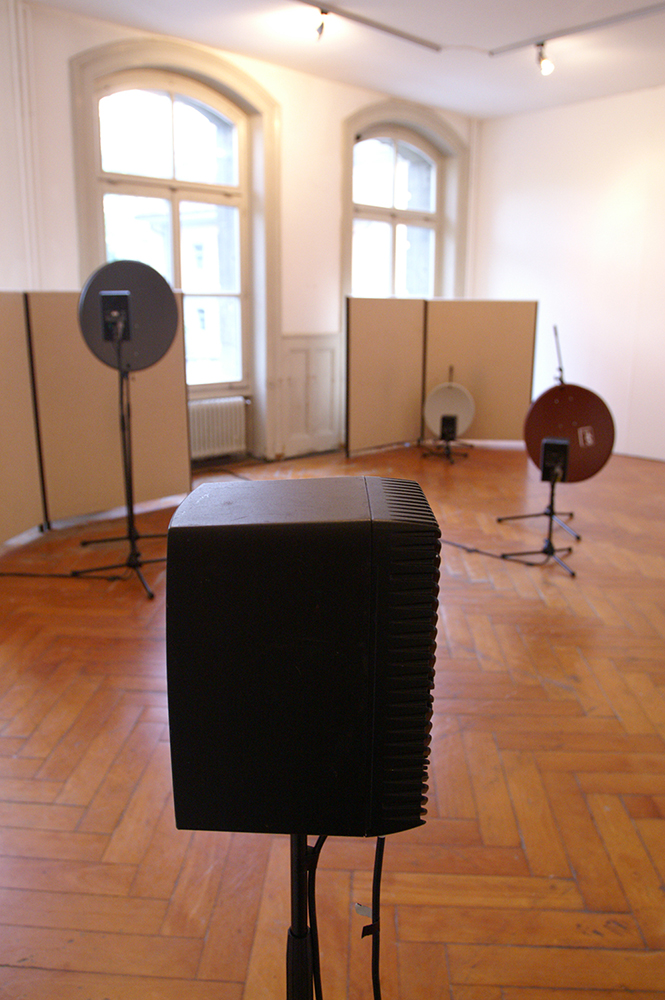
In the early 1990s, David Hockney created photographic collages consisting of many small photos that, when assembled, reproduce the entire image, e.g. of a landscape. Even though some of the individual photos were not taken from the same perspective, let alone at the same time and under the same lighting conditions, the end result is a panoramic image that can be viewed from a kind of overall perspective. Similarly, in this installation, a polyrhythmic structure is broken down into individual parts and distributed throughout the space. With a little patience and an attentive ear, one can rediscover not only the individual parts of this structure, but also the ‘overall sound’ itself in the space. To make this possible, the loudspeakers must be strongly directional in order to form a kind of sound beam. Similar to targeting a point in the room with different lasers. I use satellite dishes for this purpose. The loudspeakers are directed towards the dishes, which send the sound beam to a specific point.
This sound installation is very calm and gentle and requires concentrated listening. Even small background and external noises can be distracting.
For each satellite dish, a loudspeaker is positioned at the focal point so that its membrane is directed towards the centre of the dish. The satellite dishes themselves are aligned so that the reflection of the sound waves meet at exactly one point in the room. This alone is not an easy task, as every smooth surface within the room also functions as a reflective surface. It is therefore advantageous to use a room that is as acoustically dry as possible.
Each loudspeaker/satellite dish is now assigned a sound character. 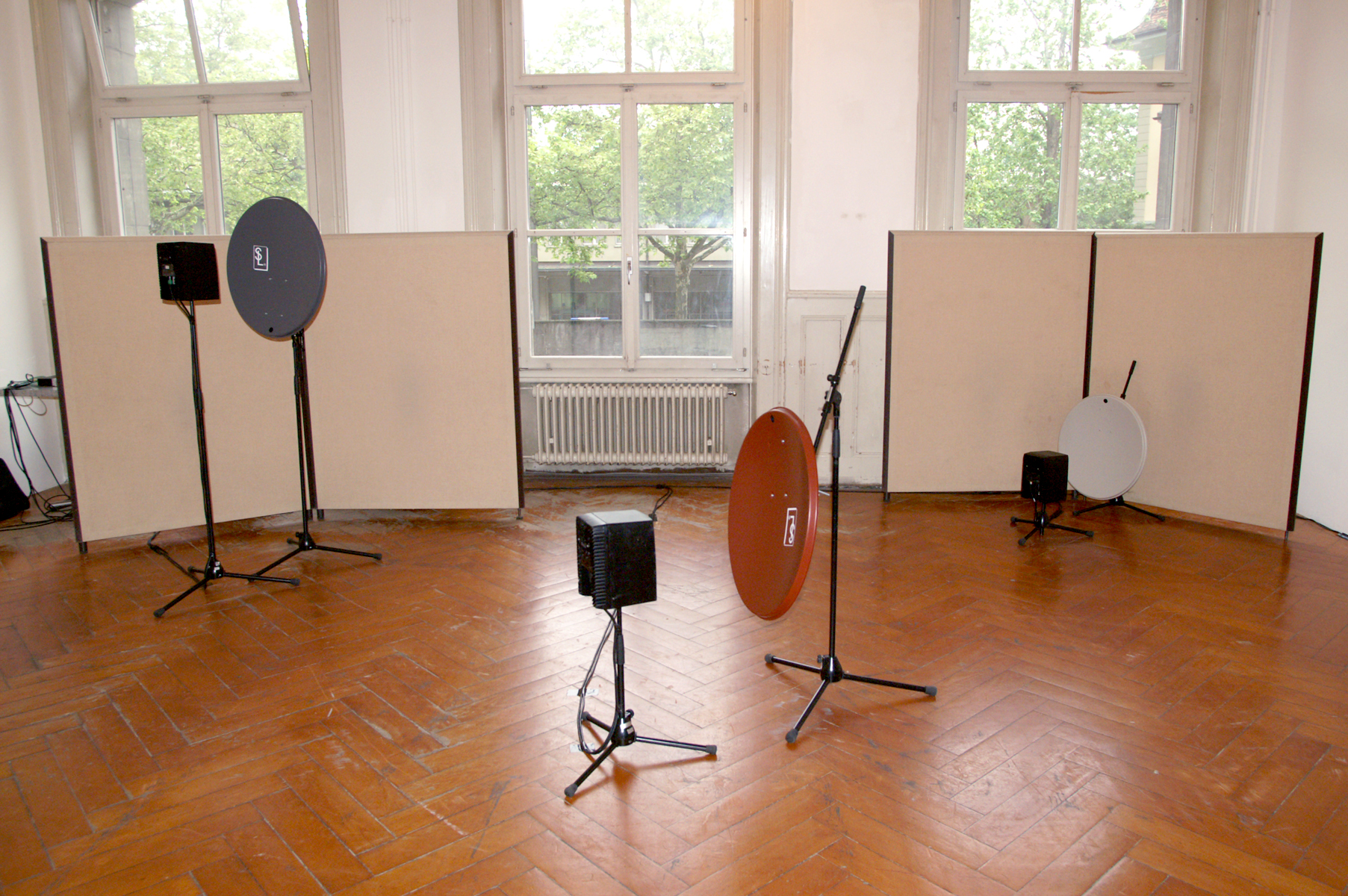 The sound material consists of hissing, noise and breathing sounds from the mouth, as well as synthetically generated similar sounds. There are several reasons why this sound material was chosen. The frequencies of the selected sounds can be more strongly directed and located, which increases the concentration of the sound beam. These sounds are also well suited as percussive elements, which makes it more difficult to find the sound beams than if it were a continuous sound surface, because it is possible to walk through the sound beam exactly in the pause between two impulses.
The mixture of synthetic and analogue/acoustic sounds has the advantage that the synthetic sounds can always be varied slightly and therefore do not have to run in a loop, while the mouth sounds create a break in perception but also generate an organic breathing pulse.
At the meeting point of the sound sources, one hears a rhythmic structure consisting of the various sound characters, which constantly changes slightly and moves between two extremes, a four-beat 4/4 time signature and a strongly polyrhythmic long-beat period.
Although the orientation of the dishes provides visual guidance, finding the individual sound beams and the point where they meet requires a great deal of patience and very concentrated listening. Depending on the position of your head, it is even possible to stand exactly at the point where the sound waves meet and hear nothing.
Sounds
wispern consists of impulsive whispering sounds, hissing and rustling made with the voice and mouth (‘Shh...’ ‘Fff...’ and similar). In addition, there are synthetic sounds made from filtered noise with volume envelopes that attempt to imitate these sounds. The sounds are assigned five characteristics:
- soft, ‘Ffff’
- soft with a hard attack, ‘Pffff’
- rough and short, ‘Tscht’
- short and hard, ‘Pff’
- ‘panting’ with the nose
The original version consists of 26 ‘natural’ sounds and 16 synthetic ones.
The five characteristics are assigned to the five loudspeakers. The transition from one sample to the next in the player is determined by probability. Samples that are more similar to each other are more likely to follow each other than samples that are less similar. In order to make the sound of the individual samples per player a little more dynamic, the output of each player is slightly filtered with a comb filter whose characteristics always change slightly within a narrow range.
Rhythm
The polyrhythmic structure creates the ‘overall picture’ and is therefore of central importance in wispern. In order to create or maintain a certain abstraction, the rhythmic structure oscillates between two extremes: a four-beat 4/4 pattern and a long-beat period that is not defined more precisely (in the original version, there are possibilities for subdivisions in beats from 1/2 to 1/12 of patterns between 16, 24, 33 or 47 beats as time signatures. The time signatures change according to a principle of chance and probability in such a way that they change steadily but never abruptly, and that the two extremes occur very rarely. The structure of the triggered sounds is determined as follows: each player adopts the same pattern (but not necessarily the same subdivision into beats). The pattern is counted up from 1 to x (between 16 and 47) in BPM = 75. Now a system is to be developed that selects the numbers that trigger sounds according to certain rules. How this is done in detail is left to the interpreter, but it should be possible to oscillate between strong abstraction and comprehensible rhythms.
Note on the video
Documenting a work of art is always problematic. In this case, technical limitations pose an additional hurdle. The sounds are so quiet that they can only be heard at maximum volume. As a result, the video is dominated mainly by external noises (passing cars, people whistling and the installation in the next room) as well as the inherent noise of the microphone, preamplifier and recorder.
The work was first realised in June 2010 in the exhibition area of the Stadtgalerie Bern.
Photos © David Schwery