A two-part invention
Three minutes of no way of knowing is the compositional realisation of an excerpt from a poem by Robert Lax's 21 pages.
In order to use the most system-immanent sound source, Lax's own voice from the film Poet Robert Lax by Nicolas Humbert and Werner Penzel was used. The background noises are recordings from the house and surroundings in Patmos, where Lax lived for almost 40 years. They are used as soundscapes, as an ‘insight’ into Lax's environment.
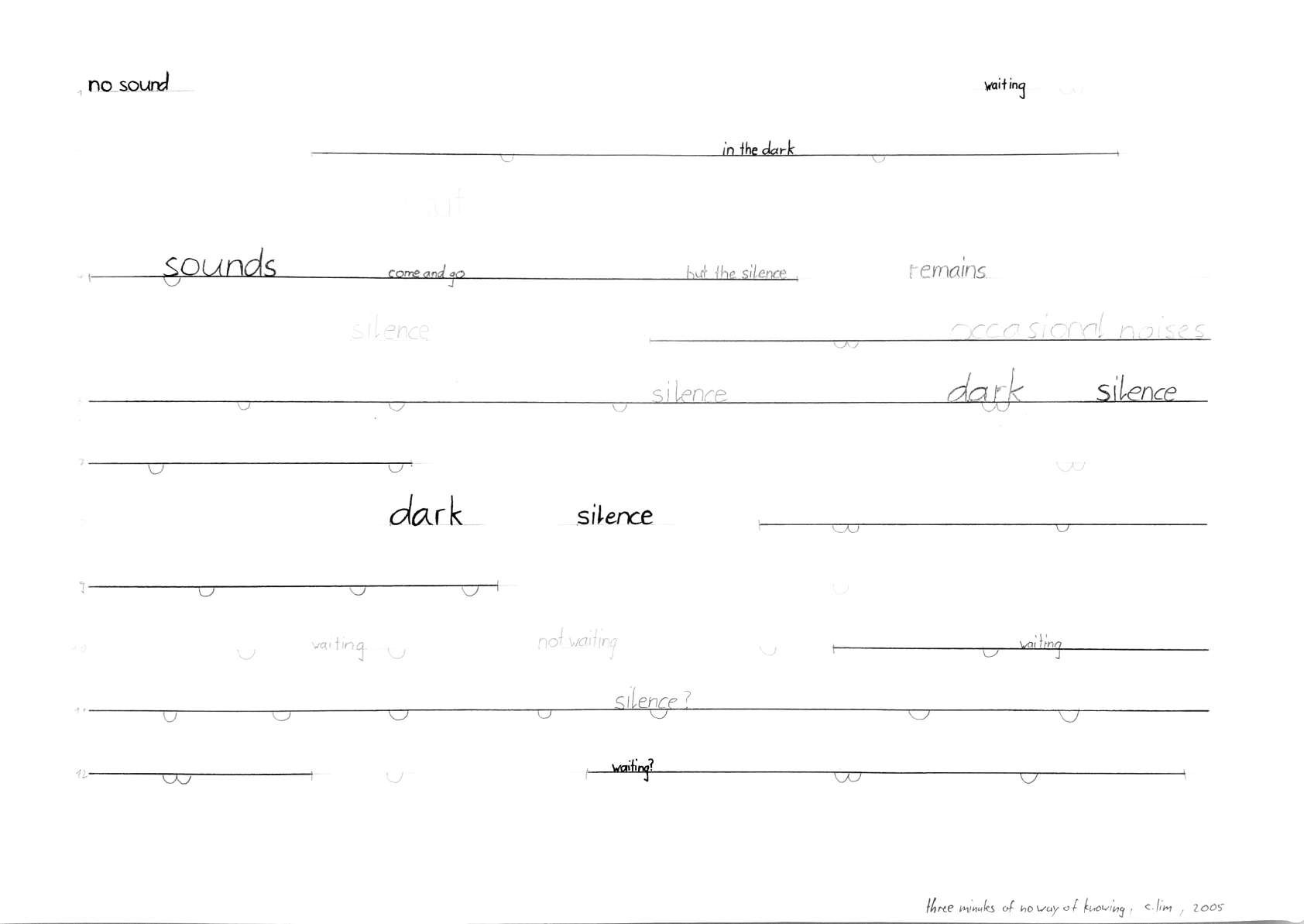
Lax's philosophical openness is similar to that of John Cage. Thus, in three minutes of no way of knowing, there are also similarities to the American composer:
the pauses between words, the questions about nothingness and the examination of silence itself are a reference to Cage's silence.
After just the first two words, ‘no sound’, a contradiction is introduced: silence – no silence. The statement ‘waiting – not waiting – waiting’ appears just as contradictory. Finally, Lax's voice poses the two questions: ‘Silence? Waiting?’ And thus leads directly to the conclusion: ‘I have no way of knowing’.
The implementation of Poésie sonor refers once again to John Cage. The statement ‘no way of knowing’ is added as a rhythmic bass pattern to the composition, thus creating a reference to the percussion part from John Cage's Ryoanji.
The conclusion ‘no way of knowing’ was semantically emptied by removing the linguistic information via a filter in order to condense the statement of the poem. The filter removed all frequencies higher than 150 Hz. What remains is the sound. This semantically emptied bass pattern refers to the subtitle ‘2-part invention’. This is done through the two vocal tracks by Robert Lax, which are used contrapuntally.
A third level is added in the form of a spatial-dynamic change. Through the sometimes abstract changes in the location of the voice source, it implies timelessness, the zero point of time, or even the possible movement of nothingness, darkness and silence.