for 4–6 performers with portable analogue radios
Introduction
In 1920, the famous coloratura soprano Nellie Melba trilled two arias and her celebrated trill into the microphone in honour of the first live broadcast of British radio—the first public radio broadcast worldwide. The sounds of Home, Sweet Home could be heard across half the globe, albeit in modest quality. Not only were radio transmitters and receivers still in their infancy; recording technology itself was also only beginning to develop. For this reason, a research project was launched a year ago with the aim of reproducing Melba’s famous voice using a microphone and transmitter from the early 1920s and a crystal radio receiver.
Yet it is not only Melba’s voice that risks disappearing into the ether. Our analogue radio, too, is increasingly giving way to digital technology almost exactly one hundred years after Guglielmo Marconi’s pioneering first transatlantic wireless transmission. FM and AM radio technology are not only historically significant for the entire twentieth century; the receivers—built in a wide variety of designs and commonly referred to simply as “radios”—are remarkable, multifaceted, and highly sensitive electronic sound generators. They are sensitive because they receive not only the modulated radio waves for which they are intended, but also cosmic or other naturally occurring electrical impulses, as well as interference from various electronic devices.
The composition Listening for Nellie treats the radio as an instrument and seeks to explore—and bring into resonance—movement and relation, cultural space and geographical place, as well as the surrounding environment. The radio as an instrument opens up unexpected possibilities. As the radio artist Gregory Whitehead once described:
"[...] radio is certainly most captivating as a place, but a place of constantly shifting borders and multiple identities, a no place where the living can dance with the dead, where voices can gather, mix, become something else, and then disappear into the night – degenerates in dreamland"
Experimental Sound and Radio (pp.89-95), MIT Press, 2001
Radio as an Instrument
To master a radio as an instrument is probably, from the outset, an endeavour doomed to fail. On the one hand, because we cannot control what is broadcast or when; on the other, because the devices react very sensitively and behave quite differently depending on location, temperature, the orientation of the device or its antenna, whether it is held with one hand or two, whether it is placed on a table, and so forth.
To conclude from this that one therefore does not need to practise the instrument would, however, be a fatal misconception. The opposite is true: precisely because radios are so sensitive, and because they can respond differently depending on these many factors, understanding and becoming familiar with the properties of the instrument being used is essential. Without such understanding, it is hardly possible to develop a functioning instrumental setup and an adapted score for a given performance space.
Required Materials
- One portable, analogue, wireless radio per performer with the following features:
- AM: shortwave (SW), medium wave (MW), and long wave (LW)
- FM: VHF/FM band
- Volume control
- On/off switch
- Continuous (non-stepped) tuning control for frequencies
- Antenna
- Batteries and spare batteries for the radios (for reasons of sustainability, rechargeable batteries are preferable)
- A number of small FM transmitters corresponding to the number of radios
- For each FM transmitter, a means of feeding it with an audio signal (for example via a smartphone using Bluetooth, USB, or a 3.5 mm jack cable, or via the outputs of an audio interface, etc.)
Preparation
The preparation consists of:
- individual exploration/practice of the radio
- preparation/creation of multiple audio tracks to be broadcast via FM transmitters during the performance, and
- performance preparation prior to the concert
Individual Exploration / Practice of the Radio
Each performer explores their radio individually.
For example:
- By systematically scanning all available frequencies
how to produce:
- purely mechanical sounds by pressing buttons, turning knobs, extending the antenna, etc.
- interference sounds generated by pressing buttons, turning knobs, or moving/touching the antenna
- interference sounds found on different bands outside of actual radio stations
- interference sounds caused by movement within the performance space
- changes in timbre through adjusting volume and—if available—the tone control
- …
Or how the radio behaves when:
- it is placed on a table or the floor
- it is held with one hand / two hands
- it is tilted to one side
- it is near other electronic devices
- …
and additionally:
- are the interference sounds / broadcast frequencies reproducible?
- are they reproducible independently of location?
etc...
Based on this exploration, the instrumentation is determined.
A mechanical instrumentation, which applies to the radio itself, independent of the performance space, and remains the same each time. And a radio-transmitter instrumentation, which is established anew before each performance and influences the durations of the individual sections. More details can be found under Performance Preparation.
Preparation / Creation of Audio Tracks for FM Transmitters
During the performance, it is possible to receive signals from multiple mock transmitters on the FM band. However, up until the final section of the score, these mock transmissions may not necessarily appear.
Each radio—or transmitter—has its own audio track. The tracks are created by selecting and editing excerpts from radio broadcasts that were transmitted in the past from multiple countries. The excerpts must contain spoken language. These can be, for example, historical events, but may also be recently recorded broadcasts of any kind.
After a maximum of 30 seconds, one excerpt should give way to an excerpt from a different broadcast. It is important that the transition from one excerpt to the next feels “natural,” so that the listener has the impression of remaining on the same radio station.
The only exception to the rule of using spoken-language excerpts is that recordings of Nellie Melba’s music may be used. Even these, however, should not exceed 30 seconds, except in the final section. In the final section of the composition, only recordings of Nellie Melba are broadcast.
Performance Preparation
As the composition is site-specific, appropriate preparation is required for each new performance location.
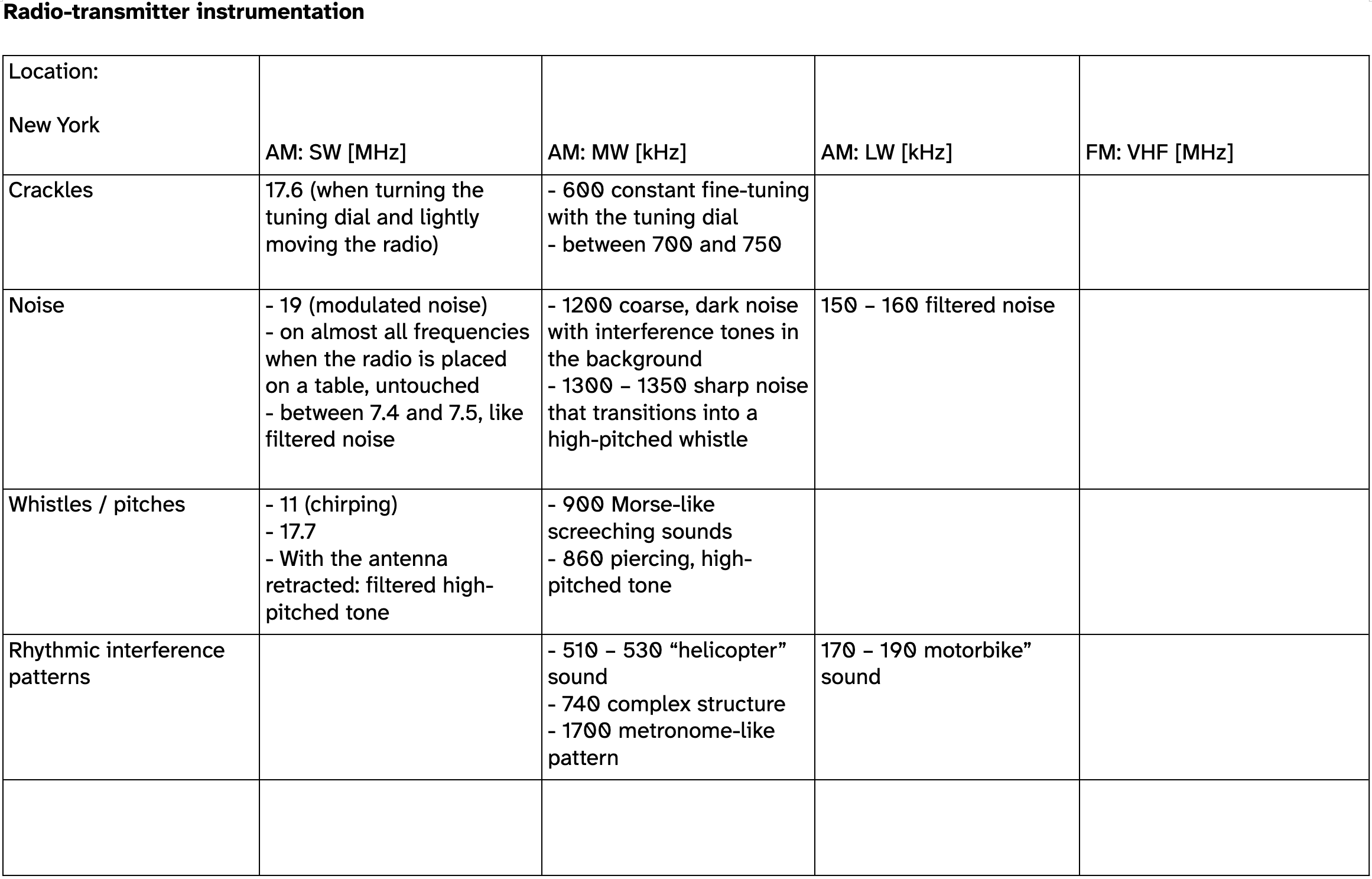
Within the radio-transmitter instrumentation, the broadcast frequencies to be used in order to produce a particular sound or character are determined. Since these frequencies depend on the performance space, the radio-transmitter instrumentation must be defined anew for each performance.
Defining the radio-transmitter instrumentation:
Find ways to elicit sounds from the radio in the following categories:
- Crackles
- Whistles / pitches
- Rhythmic interference patterns
- Noise
Select at least three frequencies per category. Each performer decides individually which sound belongs in which category.
The categories may be extended as desired, and more than three frequencies can be chosen per category. However, the more frequencies or sounds added to the instrumentation, the more complex the instrument becomes.
It is advisable to record the chosen instrumentation in writing. It remains valid for the duration of a single performance.
In addition to the instrumentation, a method should be explored to play the radio in a Theremin-like manner using the distance of the hands from the device. This means the radio must remain on the floor or on a table, without the hands touching it. For example, the distance of the hands could alter the volume or the timbre of an interference sound.
A radio-transmitter instrumentation could, for example, look like this:
In addition to the radio-transmitter instrumentation, a mechanical instrumentation is established. This applies to all performances and to the specific radio model chosen.
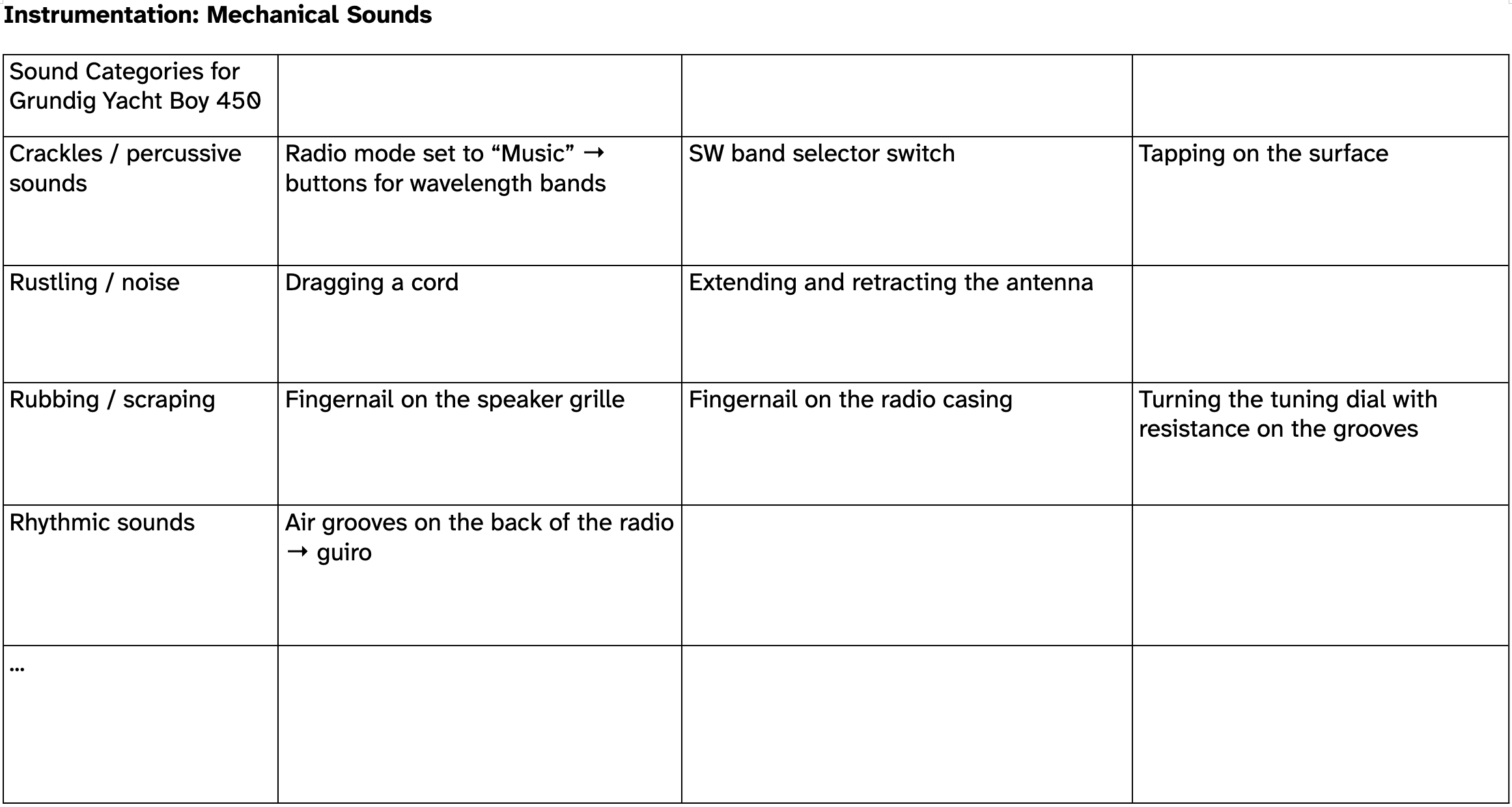
Unlike the radio-transmitter instrumentation, the mechanical instrumentation does not consist of sounds received via the radio’s speaker from broadcasts. Instead, it consists of purely mechanical sounds produced directly on the device itself. The radio is played only by hand.
Defining the mechanical instrumentation:
Create a list of at least seven sounds that can be mechanically produced on the radio.
The sounds can be freely chosen, but it may be helpful—similar to the radio-transmitter instrumentation—to define sound categories and explore different sound characters. For example, categories such as:
- Crackling
- Rustling
- Rubbing
- Scraping
- etc.
It is advisable to record the chosen mechanical instrumentation in writing. A mechanical instrumentation could, for example, look like this:
At each performance venue, the FM transmitters are distributed randomly throughout the space. Ideally, the transmission frequencies are assigned to randomly available free frequencies. The volume levels of the FM transmitters are adjusted to match the real stations.
Since the quality and quantity of sound categories may vary depending on the venue, the score—or the duration of individual sections—can be adapted accordingly. The total duration of the score is approximately 12 minutes. The rough duration of each performance section is determined collaboratively for each venue.
Score
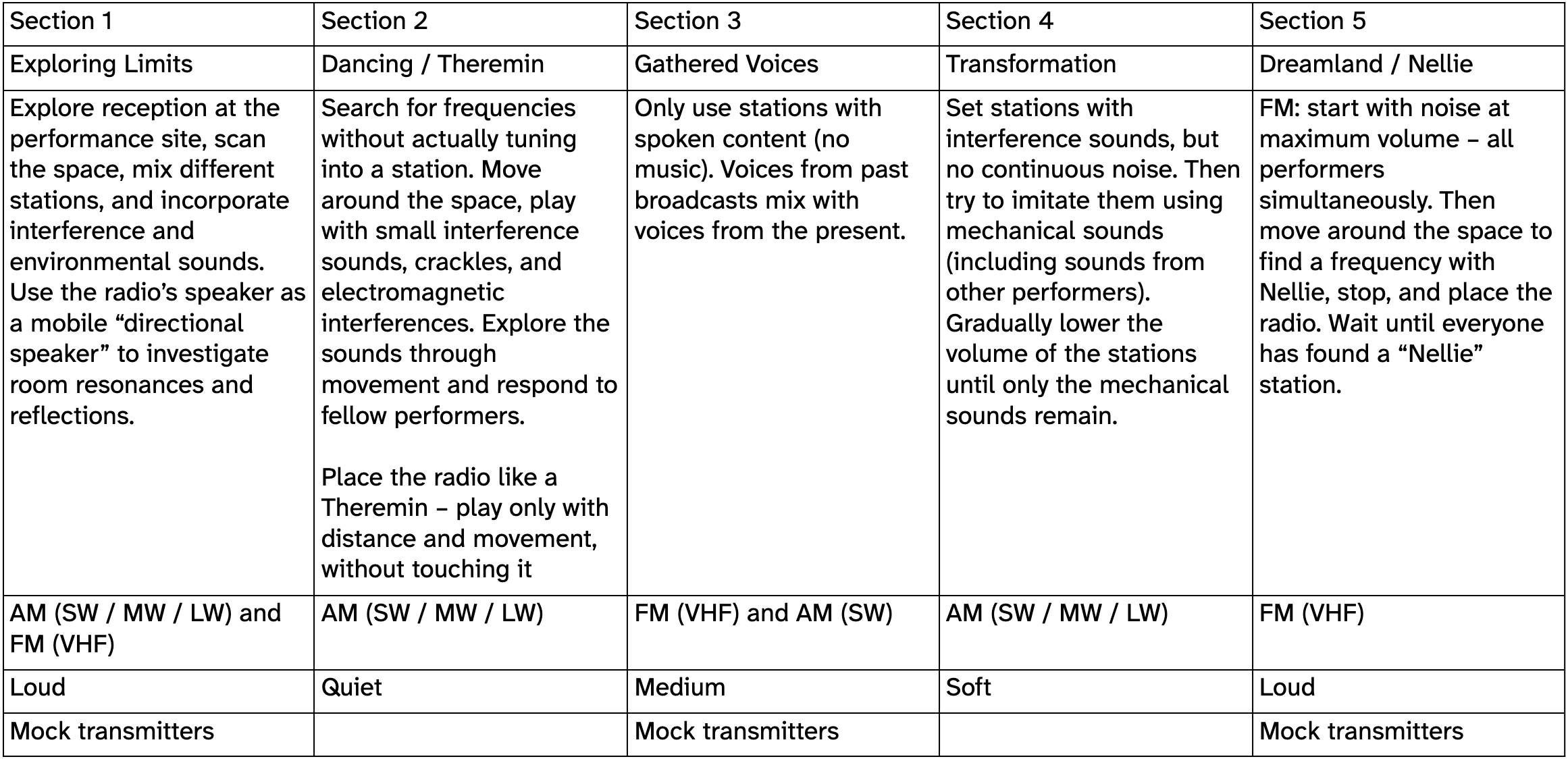
Overview of the five sections:
- Transitions are only roughly synchronised, or intertwined. This means there is no single moment when all performers move to the next section, except from Section 4 to Section 5.
- Performance sections may be shorter if less sound material is found, in favour of sections where a lot of sound material is available.
- Actions within a section do not need to occur chronologically. Actions may be repeated. The duration of actions is left open.
- The previously defined instrumentation is used to produce the sounds described in the actions.
- When encountering a station in AM mode (not FM), pause and try to adjust it as accurately as possible before continuing to explore the frequency band (music stations are allowed at any time, even if the section specifies no music).
- When encountering a station in FM mode and you think you hear Nellie Melba singing, pause and try to adjust it as accurately as possible before continuing to explore the frequency band (this is allowed at any time, even if the section specifies no music).
- The ending of the piece is decided collectively. If the mock transmitter’s sound track allows, one possibility is that the radios tuned to the “Nellie” stations continue sounding as an installation-like sculpture. Alternatively, the radios can be turned off together or sequentially, or faded out.
Description of the Performance Sections
In principle, the actions listed in the score table are intended to leave a large degree of freedom in execution, so that the performers can both develop their own version of the composition and better respond to the venue-specific and device-specific conditions. The following, slightly more detailed description of each section is therefore intended to convey a sense of mood or focus for the respective performance sections.
Section 1 (Exploring Limits)
Exploration here takes place on several levels. First, explore the local receivable stations (the FM band is particularly suitable for this), but also consider the performer’s position within the performance space. At the same time, explore the acoustics of the space. The radio functions as a kind of measuring tool or sonar (here, the AM mode is also useful).
Move through the space, searching for resonances, reflections, or other interesting acoustic phenomena, using the radio as a mobile directional speaker. At the same time, investigate the FM reception for interesting phenomena. Is there perhaps a station that is only partially received? Or multiple stations on the same frequency? Does the reception change completely on a frequency if you take a single step? These two types of exploration can also be distributed among the performers.
The character of Section 1 is rather loud, spatial, and room-filling, but not chaotic.
Section 2 (Dancing / Theremin)
In the second section, physical movements create abstract, rhythmic accompaniment for the radios. Subtle movements—such as rocking the radio, slowly moving through the space, steadily turning a knob or dial, or tracing a shape in the air with the antenna—generate small, abstract rhythmic sounds.
The rhythm of these movements should align with the other performers.
Here, the radio can also be used like a Theremin. The radio is placed on a table or on the floor and played using only the distance of the hands from the device. Both performance modes can also be distributed among the performers.
The character of Section 2 is quiet, delicate, sparse, and rhythmic.
Section 3 (Gathered Voices)
Search for radio stations that broadcast only spoken content. When such a station is found, stay on that frequency for a while before searching for a new station. If searching in AM mode, it is useful to have previously explored receivable frequencies, so as not to spend too long navigating static.
While searching, the volume control can also be manipulated by hand, ensuring that the sounds do not overwhelm the spoken content.
The character of Section 3 is neither loud nor quiet, somewhat random, but focused on speech.
Section 4 (Transformation)
Interference sounds determine what is played from the mechanical instrumentation. The selected station with interference gradually becomes quieter over time, until only the mechanical sounds remain. The duration of this process is individually determined—it may last for the entire section, forming a large decrescendo of the speaker sounds, or it may be shorter and repeated as desired.
It is important that the interference from all radios of all performers is heard as a single soundscape. This means that the mechanical sounds to be played do not relate only to an individual radio, but to all radios.
For the imitation of the soundscape, specific sounds from the mechanical instrumentation are deliberately selected and performed.
The character of Section 4 is quiet (and gradually quieter), concentrated, and the character of the heard sound transforms over time.
Section 5 (Dreamland / Nellie)
This is the only section that must be started simultaneously and collectively. On the FM band, set a frequency with noise, then turn the volume to maximum. Move through the space in search of Nellie Melba. As the search progresses, gradually lower the volume. When Nellie Melba is found, place the radio.
The character of Section 5 is rather loud.
Cyrill Lim, 2022