for vocal ensemble, electronics and hanging sheets of various metals
Written for and dedicated to the Neue Vocalsolisten Stuttgart
A Reminiscence of Bas Jan Ader
Download Score (Please keep in mind that the notations for Parts IV and V in this score were exclusively for the metal sheets used in the premiere version. For another version you have to generate your own notations.)
Introduction Gedanken, ungesagt, verhallen (Thoughts, unspoken, fade away)
No traditional instruments, but industrial metal plates, are placed at the centre of the piece alongside the singers. They are equipped with an electromechanical transducer—a type of speaker—and are set into vibration by the musicians via microphones. As early as the 1960s, metal plates, so-called plate reverbs, were used in recording studios to produce artificial reverberation. Here, however, the metal plates are less refined and do not serve merely to add reverb. Their acoustic characteristics largely determine the course of the piece, as their resonance frequencies dictate the sung material. The choice of plates is therefore crucial. Depending on size, density, and material, different versions of the piece can emerge.
The progression of the piece can be described in five sections. In the first section, the plates are gently explored using very soft, percussive sounds. In the second section, a continuous descending glissando probes the overtone spectra of the metals almost scientifically. In the third section, this evolves into a pattering of water-drop-like sounds, which gradually densifies and then thins out. In the penultimate section, the resonance frequencies of the plates are sung by the sopranos, causing the sung U vowels to reverberate and sound from a distance. In the final section, the other voices join the higher voices, forming a carpet of arpeggios, which simultaneously controls the volume of sine waves—the only synthetic sound component of the piece—which gradually decouples from the human voices.
Setup
Six metal plates (more are possible), each at least 30 × 30 cm and ideally thicker than 2 mm, are suspended on stage. They can be hung close together or spaced apart, depending on visual and acoustic requirements. It is important that the plates are freely vibrating and that their oscillations are not impeded by cables, tape, or similar attachments.
The vocal ensemble positions itself behind the plates. Each musician has a microphone on a stand—preferably a dynamic microphone with a cardioid pattern.
The microphone signals are routed to the sound desk, where they are processed electronically and sent to the electromechanical transducers. These transducers (also called exciters) work most effectively when attached at the centre of the plate. A broadband exciter with approximately 2 W of power is suitable. Small, battery-powered mini-amplifiers are appropriate for driving the exciters.
Performance Instructions for the Singers
In general, the piece is quiet and intimate. Many sections are performed ad libitum within the given framework.
In addition to this description, the score consists of three other components: a graphic score providing a temporal overview; a score for the sopranos with a collection of pitches for the sung U vowels; and scores containing pitch material for the arpeggios at the end.
The sounds produced by the metal plates must not be masked by the volume of the unamplified voices. The electronics, or sound desk, are instructed to set the microphones so that even very quiet sounds are effectively transmitted to the plates. This means that all actions should ideally be executed very quietly, intimately, and close to the microphone.
All five sections of the piece flow into one another, except for the final section.
Part I (Comb Sounds “rrrr” in the throat):
I call these sounds “comb sounds” because they remind me of the sound produced when a fingernail is drawn across the teeth of a comb. I imagine this sound as slightly rising and falling, somewhat searching in pitch. Here is an example from the Experiment-Stimme workshop with the Neue Vocalsolisten:
 In the graphic score, these are notated as small, successive points. However, the score is not meant to be taken “literally.” The idea is that during the period in which these symbols appear, the sounds are performed ad libitum. It is not necessary for all voices to participate. What is important is that only one person begins at the start, and that in the first ~40 seconds there are also pauses—silences in between.
Part II (slow, continuous glissando, alternating in pairs):
Over a period of approximately 2′30″, a maximally open, overtone-rich [a] is sung with a continuously falling pitch. It begins on a′′ and ends on G. The tone should always be handed over, so that no gaps occur. In my conception, the mezzo-soprano begins and alternates first with the tenor; then the baritone takes over the mezzo-soprano’s role and alternates with the tenor, until the bass replaces the tenor and alternates with the baritone. The exact implementation is left to the ensemble.
The overtone-rich [a] excites many overtones in the metal plates, producing very resonant spectra. The challenge is to sing quietly enough so that the metal plates are not overwhelmed. It is important to note that the person singing at any given moment hears the effect least clearly. This should not be discouraging, and it is advisable during rehearsals for one person to listen only and provide feedback.
The glissando should fall continuously, but the performers are free to play with the resulting sounds. This means that if a particularly beautiful or interesting spot occurs, one may remain on that pitch for a while. The overall duration of the glissando is only a rough guideline.
As the glissando begins, the comb sounds gradually become quieter and fewer, eventually ceasing entirely. Part III begins before the glissando concludes.
Part III (Droplet Sounds):
Sounds reminiscent of water droplets are produced using percussive mouth noises or “plop” sounds. Listen to examples here (mouth sounds only):
and here (on the metal plates):
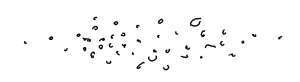 The droplet sounds should initially occur individually, then gradually densify towards the middle, and finally thin out again.
Part IV begins during this thinning phase.
Part IV (“uuu” tones):
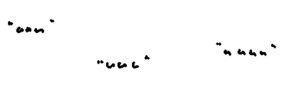 The pitch material for the sung vowels is determined by the dominant resonance frequencies of the metal plates. This means that the “reverb” effect is most strongly expressed at these frequencies. Since the resonance frequencies depend on the density and size of the material, their exact locations fall somewhere between the notes of our conventional notation system.
Deviations are indicated in cents relative to the nearest note (A = 443 Hz). It is not crucial to hit these deviations exactly; the indications are provided merely as a reference. Some tones may respond better, others less so.
Which pitches are chosen and when they are sung is left to the performers, ad libitum. Pauses—silences—should also be allowed, and it is perfectly acceptable for pitches sung by the two sopranos to overlap in time. Each tone should last approximately 3–5 seconds. Dynamically, this section may be louder than the preceding sections.
Part V (Arpeggios):
 The transition between Part IV and Part V is the only direct, non-overlapping transition in the piece. Dynamically, Part V continues from Part IV. As in Part IV, the arpeggios are based on a collection of pitches. Not all bars need to be sung. Performers may begin at bar 1, bar 9, or any other chosen bar, but all must sing the same bar.
The arpeggios are not constructed from bass to soprano. Their structure is determined by the horizontal alignment of the notes within each bar. Each bar lasts approximately 6–8 seconds, with a brief pause between bars.
The sopranos sing over the first four bars, moving from a closed vowel toward a hum (with the mouth gradually closing). The other singers begin immediately with humming. The overall duration of the final section is also ad libitum. Towards the end, however, a collective decrescendo emerges, both through the dynamics of singing/humming and through the gradual movement of the mouth away from the microphone. The ensemble is responsible for coordinating the final section themselves.
Silence.
End.
Performance Instructions for Electronics / Sound Direction
For the most part, the singers’ voices are simply amplified. In this context, “amplified” means that the signals are routed to the exciters attached to the metal plates. For this purpose, the microphones must be heavily compressed or limited so that the output level can be adjusted precisely. This is important in order to obtain the maximum effect from the plates without causing the exciters to overload.
If possible, each microphone signal should be sent to all plates. Depending on the plate and the section, however, it may be useful not to drive a particular plate—for example, if the amplification would dominate rather than the effect of the overtones or resonance frequencies.
In Part II, the effect of the overtone spectra may be enhanced by emphasising the first five overtones of the voice. This can be achieved through transposition or by means of a harmonic filter, though only if it appears necessary.
In the final part, sine tones are sent to the metal plates. There is one sine-wave generator per plate. Each microphone controls the volume of one generator via an envelope follower.
Each plate has its own pool of frequencies, from which a new frequency is selected at random during each pause between the arpeggios.
The frequency pool is determined by analysing the frequency response of the respective plate. For this purpose, a neutral small-diaphragm condenser microphone is placed in front of the plate. An electronic sweep of approximately 50 Hz to 1500 Hz is sent through the exciter and recorded by the microphone. Using this impulse response (IR) method, a waterfall diagram can be generated, from which the decay times of the resonance frequencies can be determined.
Cyrill Lim, 2019