for 16 harps and live-electronics
Commissioned for Zeiträume Basel – Biennial for New Music and Architecture
Download Score
Each harp is equipped with a microphone and a transducer. The transducer gets attached to the harp’s resonant body to transmit electromechanical energy into the instrument thus
turning the harp into a kind of speaker.
The harp’s sound gets picked up by the microphone, delayed for some seconds and played back into the harp through the transducer. Thus every instrument establishes a self-contained feedback system.
Due to the natural and individual sound characteristics of each instrument, frequencies will get reinforced and filtered gradually until the original sound impulse turns into a continuous tone. Because of the instruments’ directional characteristics different mic positions change the frequencies that get reinforced and filtered. The performer can therefore control the emerging sounds by moving and repositioning the microphone while the distance to the instrument controls the dynamics.
In the end of the performance, the last sound gets “freezed” by a repeating loop. What remains are the frozen filtered sounds of the resonant bodies, an installative sound sculpture which in turn gets amplified and filtered by the concert space. That way a panoply of interaction between instruments and resonant spaces develops.
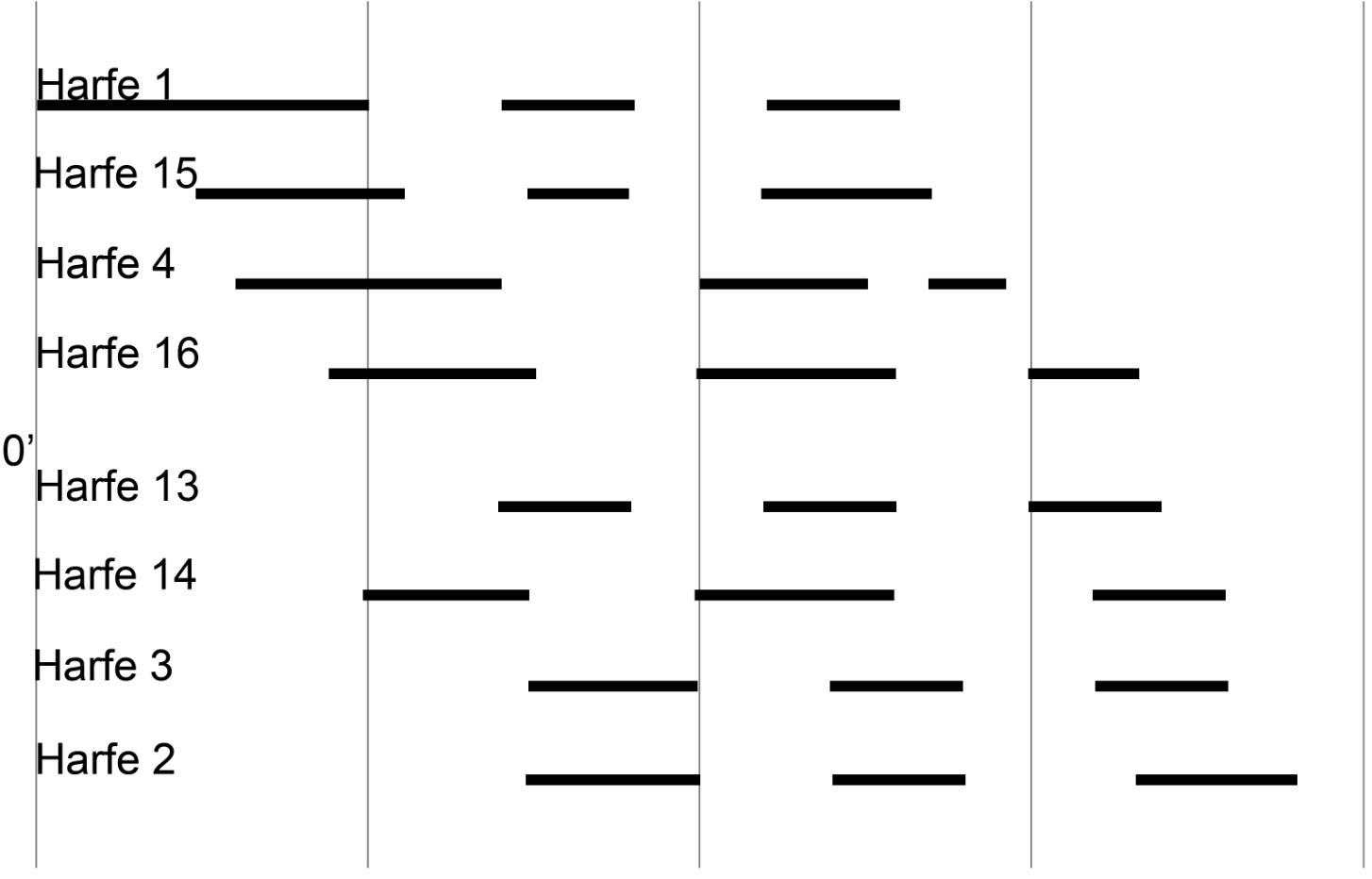
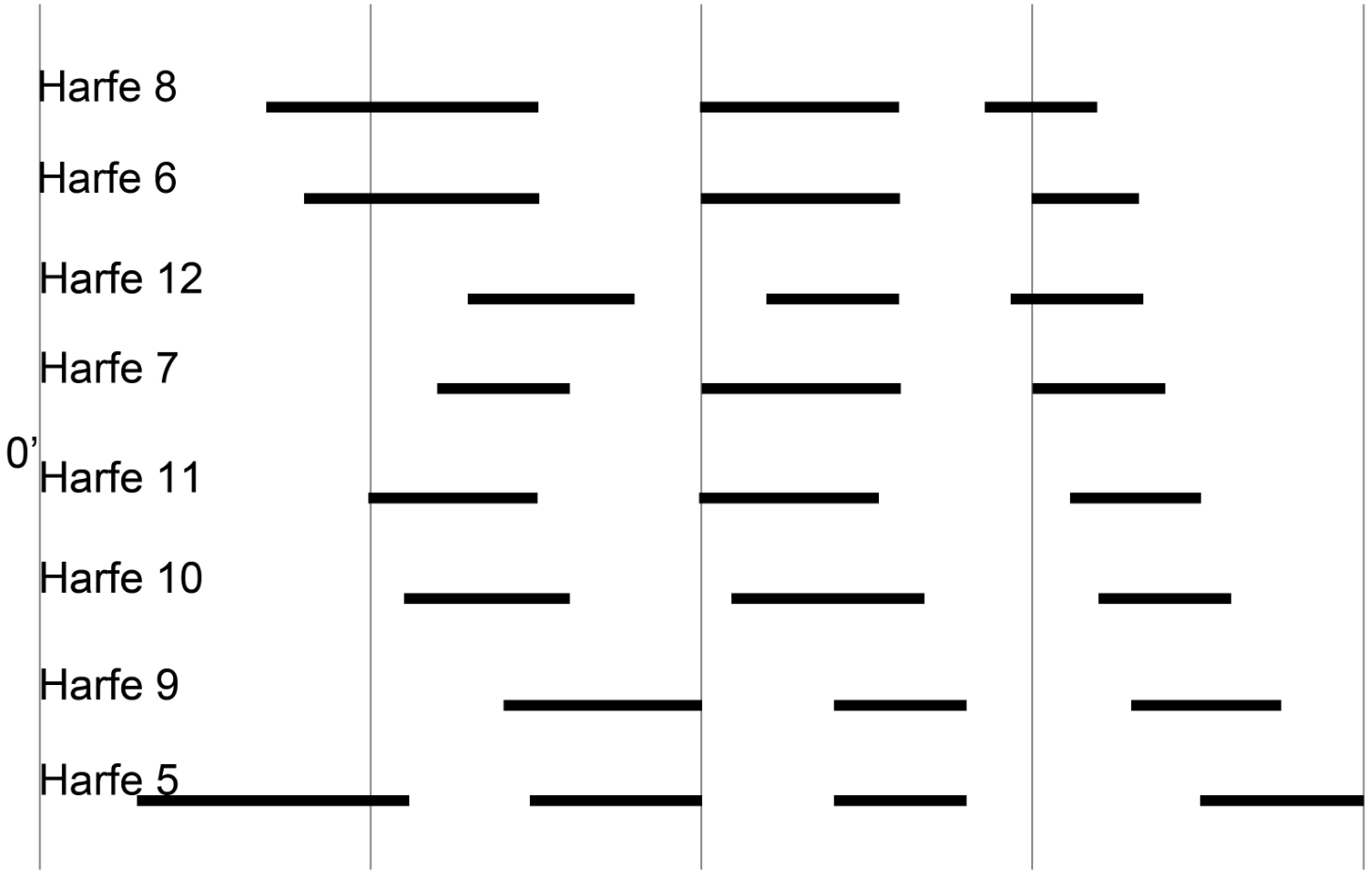
All performers start and stop at different times. Every performer has its own time structure composed of the actions “play” and “don’t play” or “pause”.
Performing instructions harp
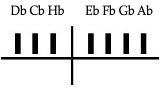
The best position to mount the transducer is around the c’’’-string, with the transducer positioned between the strings. Hold the microphone and position it close to the surface of the soundboard or body or inside of the resonant body.
The feedback system is initiated by an impulse. Knocking at the instrument or playing the soundboard with a superball can induce an impulse. No strings shall be played.
All movements with or around the harp should be carried out thoroughly and gently. To move from one microphone position to the next shouldn’t take too much time; in position the mic should rest as calm as possible. Use the mic like a stethoscope to examine the harp and to experience its own sound on a musical level. It’s important to let the ear lead your actions.
Fewer movements are preferred.
If the sound disappears induce a new impulse.
Put the microphone on the stand during a pause but stay with your instrument until you played your last sound of the performance. After that you can join the audience and move freely around.
Performing instructions electronics
Connect the microphones to the preamps of the mixing desk / audio interface.
Use a highpass and lowpass filter to eliminate outliers. Use values around 100 Hz and 1000 Hz.
Each input channel gets delayed by 4 to 5 seconds and duplicated. Compress both signals (the original and the duplicate) very hard. One signal goes into the transducer of the initial harp while the duplicate gets amplified by one of the eight speakers distributed throughout the space.
The performer’s last sound gets freezed in a repeated loop of around 5 seconds. At the same time the input signal of that microphone gets muted.
The additional amplification by the distributed speakers should be as soft as possible. During the course of a performance the amplification might get lower gradually.
If possible, it’s preferable to play without additional amplification.
The heavy compression has two tasks. On the one hand, it raises the input signal to keep the feedback from getting lower and on the other hand, it lowers the output signal to prevent the feedback from constantly getting louder.
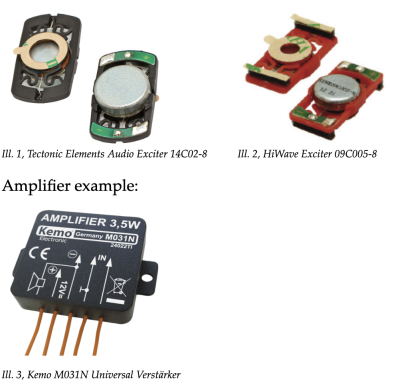
Between the audio output (audio interface) and transducer a small amplifier is needed. A battery powered amplifier should be sufficient. The transducers shouldn’t be bigger than 2 – 3 cm to minimise the influence of their self-resonance.
Small-diaphragm condenser microphones with a cardioid or hypercardioid pattern are the most qualified.
The original maxpatch for the live-electronics is available on request. However, alternative solutions and reinterpretations of the live-electronics are desirable.
Transducer examples:
Time Structures
Cyrill Lim, 2017