An artistic audio guide for the exhibition open doors corruption at the Villa Maraini by Cyrill Lim & Marcel Zaes
With Luc Mattenberger, Delphine Reist, Sabine Gisin, Pascal Janoviak & Laurent Faulon
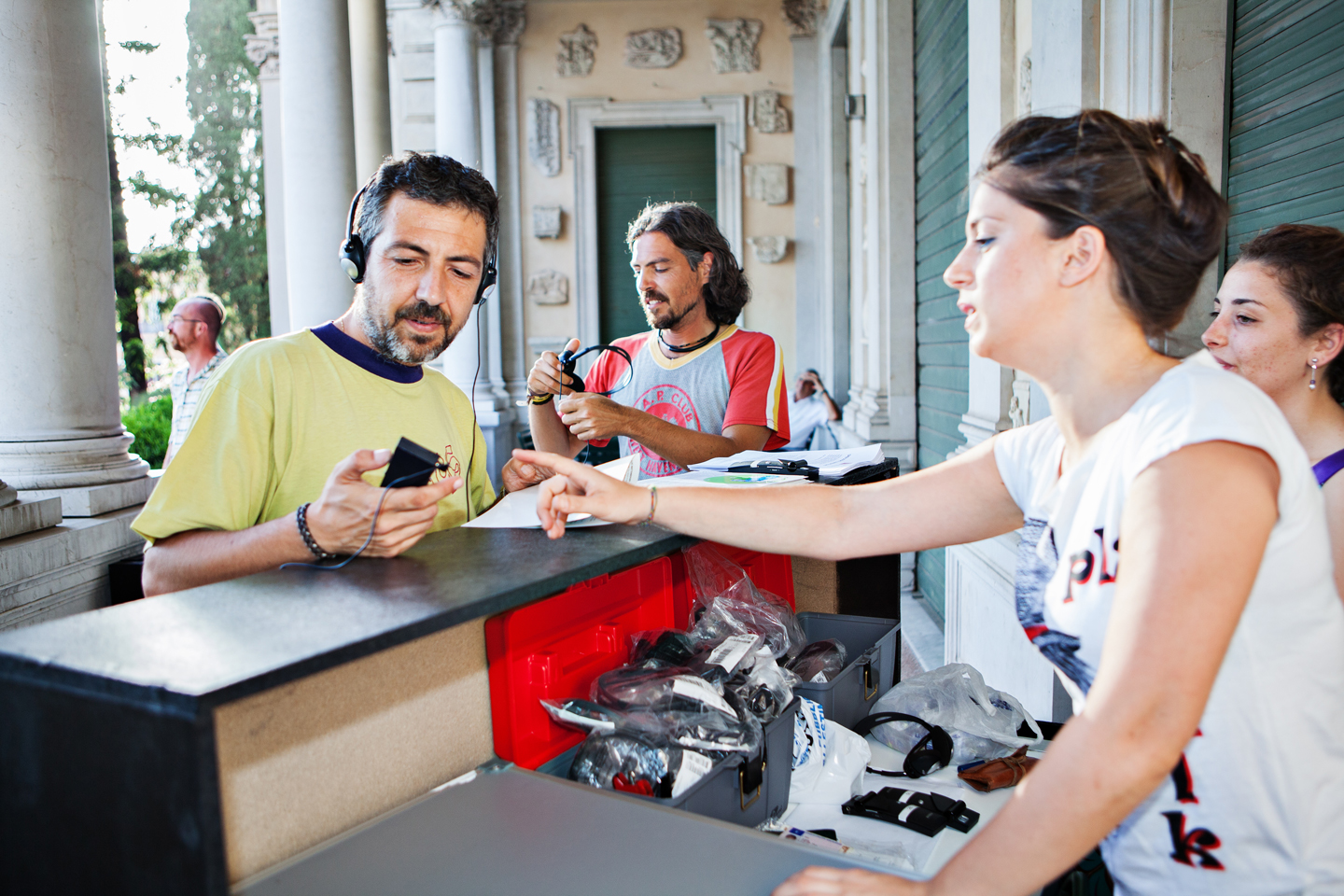
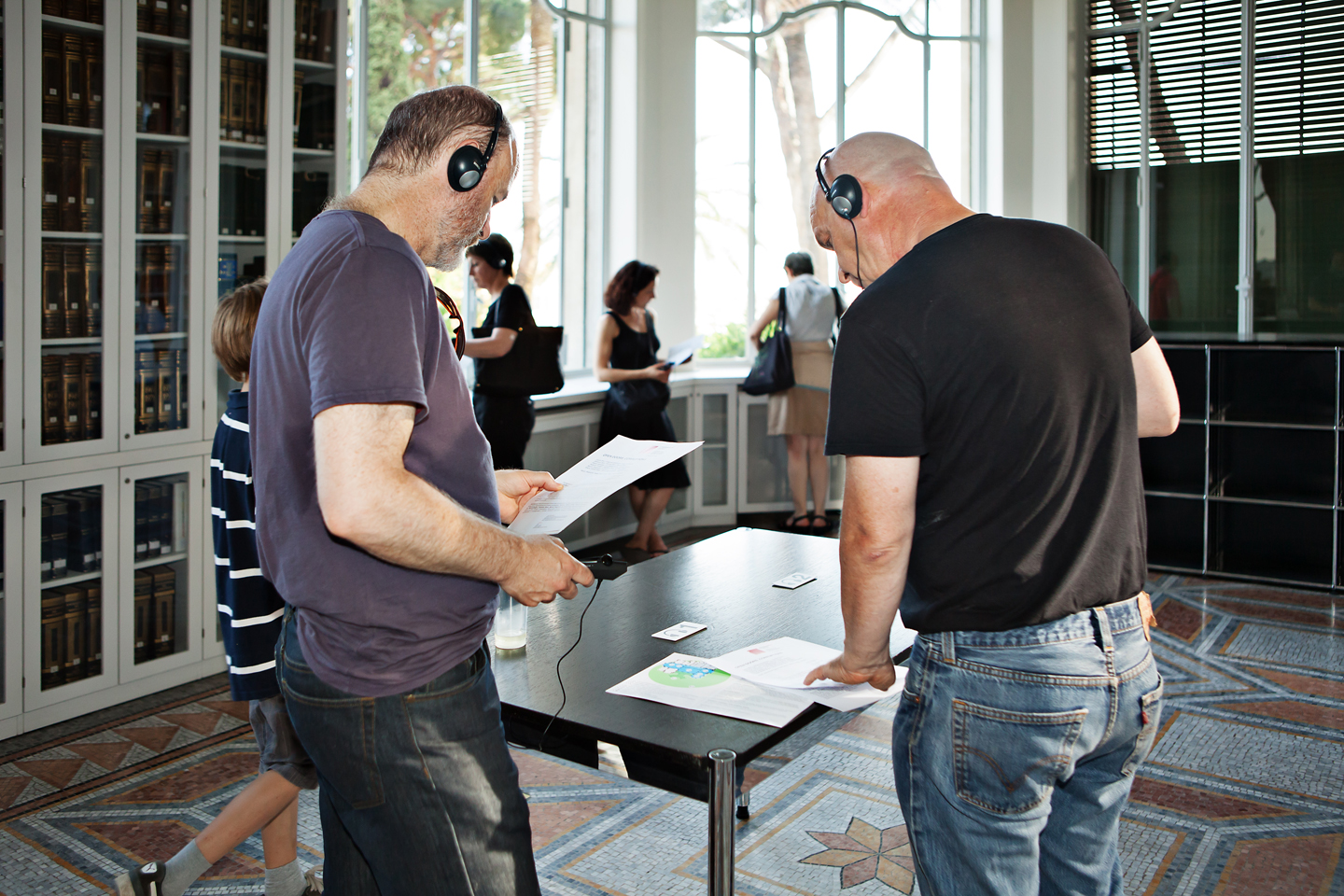
What first comes to one's mind when thinking about corruption could be a corrupt financial or political system, where one party or person buys another party or person in order to gain an advantage. Relating corruption to art may sound strange at first, but on second thought, as an artist, it is very hard not to be corruptible. Most artists depend on support from foundations, fellowships, or public authorities. In order to obtain this support, they write concepts, budgets, and time schedules, and try to adjust them to fit the required profile. At this point, the idea of their work (if they even had one) has already been altered.
But this is not the only possible corruption (we do not even bother to mention the art market) that may appear in an artist's work. At least since the dawn of the digital era, we have an almost unlimited number of technical tools and means to work with, and some of these possibilities are very tempting to use simply because they are available.
One starts to think about how to include this technology, even if it is not necessary or helpful in grasping the substance of the work. In fact, every input or feedback will somehow trigger a reflection on what we do or did, and thus corrupt us in one way or another. And by reading this, at this very moment, your perception of the exhibited artworks is already corrupted.
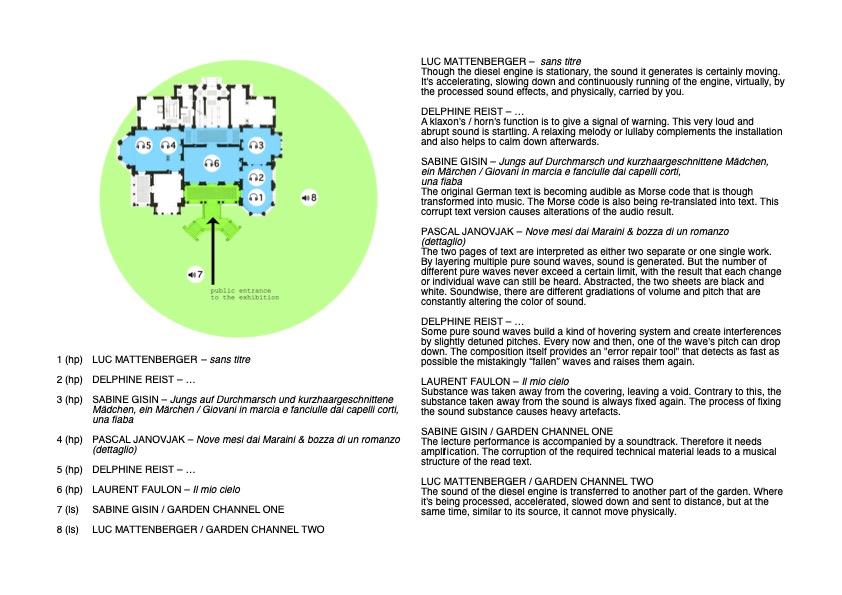
01 02 03 04 05 06 07
Work process
Corruption is inherent in the concept of infinite silent redundancy, since the goal is to create an audio guide track for each exhibited artwork that tries to corrupt the artwork in a non-destructive way and thereby offers a different possibility of perceiving the work. Therefore, we started thinking in a corrupt way about how to compose for an existing work that we wanted to alter through our own work without "hurting" it.
Secondly, we limited ourselves to using this audio guide system because of the simple fact that one is available here. This again forced us to think in a corrupt way about how to implement our compositional visions. Also, because of the geographical distance, we decided to use a shared internet folder to save and exchange files and information. We both used the same software and sources to compose and create sound, and even the same project file. This means that whenever one of us altered or added something, it also affected the work of the other.
We shared not only the same sound sources, but also the same time emitter / clock on which our compositions are based. So if one needed to change this time emitter module in order to obtain the desired data, it affected all other works as well.
To create some kind of structure, we proclaimed rules. On the one hand, the rules helped to focus and concentrate our work, but on the other hand, they again led to corruption. If one wanted the modules to sound in a certain way, he proclaimed rules that supported this vision. But if these rules got in the way of the vision of the other, he could either change the rule, ignore it, or try to alter the data in a way that, on the surface, still follows the rules but breaks them in the result.
Nevertheless, it is a cooperative work with the same goal, and it should not become destructive. So at some point, someone may have to bite the bullet and accept an alteration or rule that does not support his own intention. It is this moment of give-and-take that we wanted to achieve.
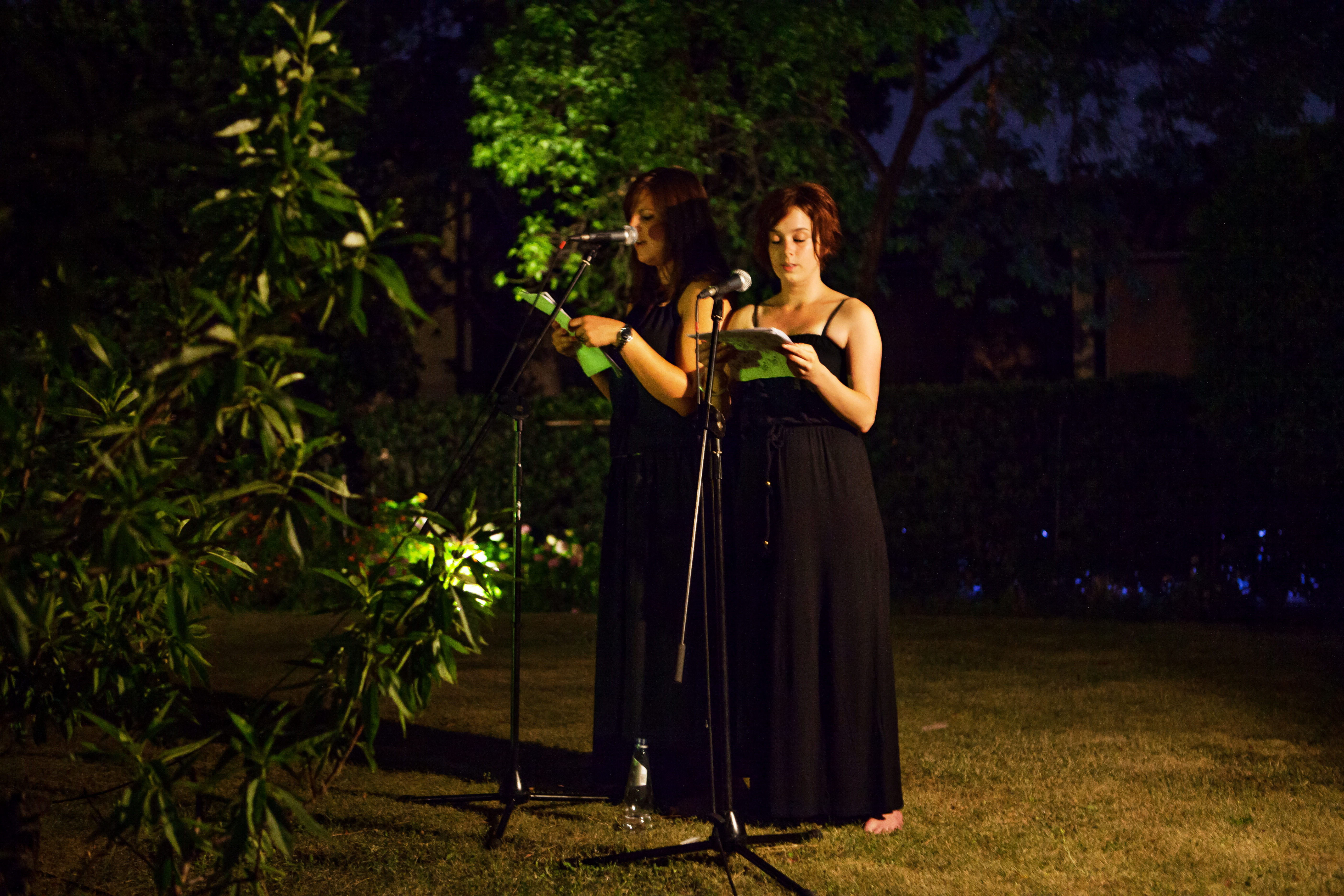
Sound
The resulting sounds may seem chaotic or even banal. But the fact is, the sounds on the different channels are not only connected within themselves, but also very connected and structured as a whole. Granted, they may not sound as they were originally intended to sound (which actually was the intention in the first place). They have been corrupted during a long mental and technical process and dialogue.
Like “corruption,” the word “redundancy” tends to have a negative connotation. Nevertheless, both expressions can also have a positive effect. In this case, our audio guide is redundant because it is not necessary to understand the artworks, but it is positive in the sense that it does not destructively (= irreversibly) alter their original information, since we are not physically “touching” or altering them.
Furthermore, we leave the choice of using the audio guide to the recipient / audience. Each spectator creates his own version by choosing his own chronological sequence of putting on and taking off his headphones, entering and leaving the villa, and changing the receiver channel.
Therefore, our audio guide installation is either a work on its own, a work that allows you to perceive the other works from another perspective, or it is simply infinite silent redundancy.
Photos © Ela Bialkowska