Composition for trombone and electronics
[video]https://www.dropbox.com/scl/fi/zig9cjqt48chzq8ext6s7/Dungchen-small.mov?rlkey=p1ql6c6ywxo8xfzm4rjzf61xh&raw=1#t=1[/video]
"Like the shuttle of a weaver's loom, the musician's extended instrument traverses the empty stage space, where the audience stands or sprawls, lane by lane. A speaker hangs on the back wall of the room, from which a gently oscillating, monotonous trombone track also sounds. Cyrill Lim recorded this at home and now responds with long, deep tones. Relationships, vibrations and waves are created."
Honne Dohrmann, 7.6.09. Excerpt from review of Outnow Festival Bremen
Beats, overtone structures, difference tones, natural phenomena that take centre stage for once. The trombone is the ideal instrument for the required microtonal playing style, for a journey through dissonances in search of consonances.
The performer strides across the 23 fixed stations in the room where the performance takes place. The length of the room determines the duration from one fixed station to the next. An assistant follows the movement with an ‘endless’ fader so that the electronics and the performer are synchronised. The performer can therefore determine the speed and can also stand still to ‘freeze’ the electronics and thus emphasise a special moment. The pitches to be played at the fixed points are only intended as a guide; the performer does not have to play the specified pitch exactly (but may do so). The sound movement between the fixed points should be slow, but interval jumps are possible. The volumes of the trombone and electronics are approximately the same, but may be relatively loud.
The material 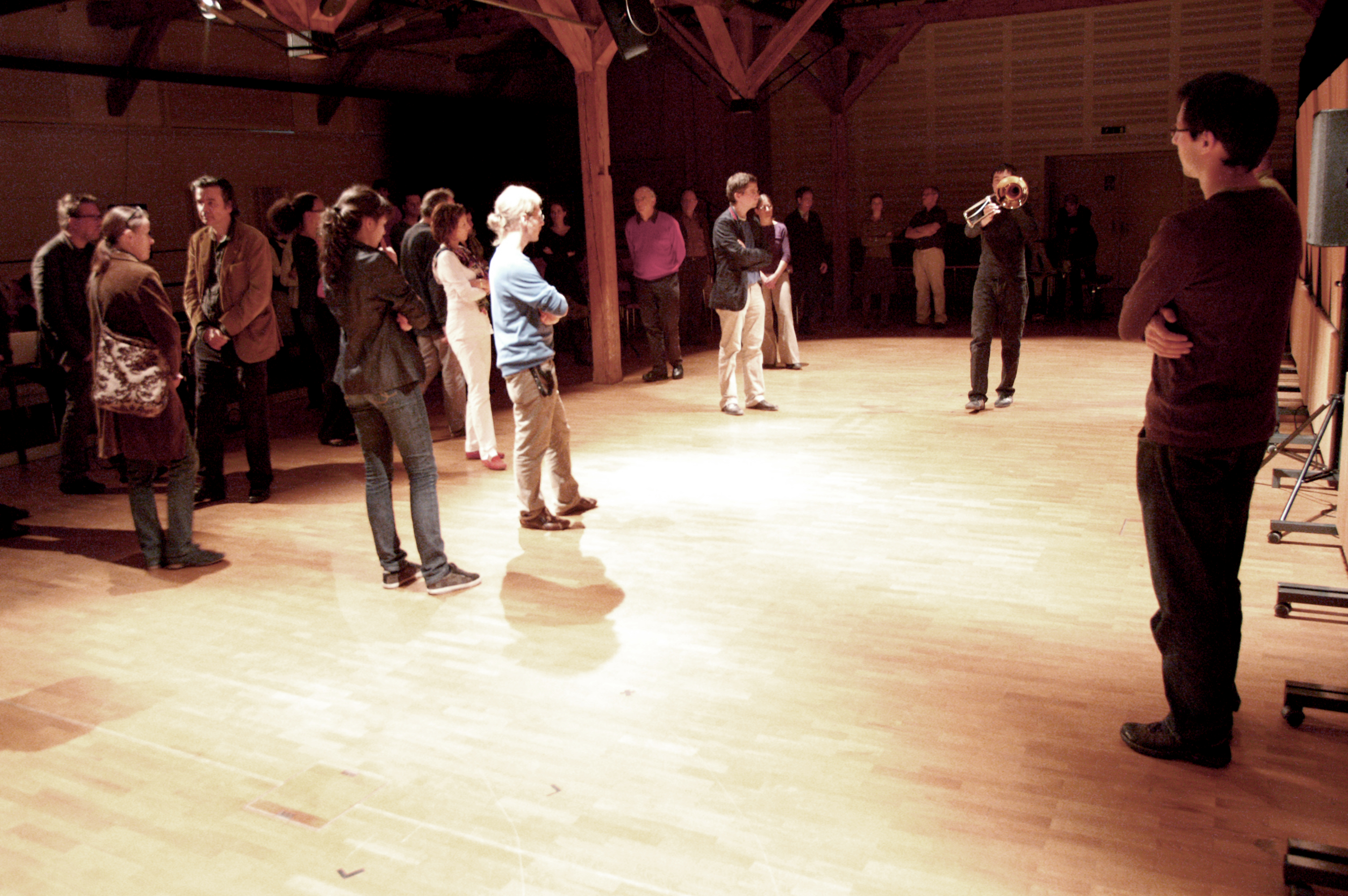
In addition to the acoustic trombone, which is played ‘normally’, the piece consists of electronic, trombone-like sounds that are synthetically generated by additive synthesis based on the analysed overtone ratios of the notes d / f / f sharp / a / dʼ / fʼ / fʼ sharp.
The progression
The progression and dramaturgy of the piece are determined by the overtone structures of the trombone. Using FFT analyses of the individual notes of a d minor or major triad (d / f / f sharp / a / dʼ / fʼ / fʼ sharp), the vibration ratios of the overtones to the fundamental tone and their amplitude values are determined. The average values of the vibration ratios, which are not pure as expected, i.e. they do not have a factor of 1, 2, 3, 4, etc., are used to obtain the overtone structures of the notes between e flat and c' sharp.
The electronics begin with a d, becoming a two-note chord (d / f), then a minor triad (d / f / a), then a minor triad plus octave (d / f / a /dʼ), then a minor triad with octave, then a minor triad with octave and tenth, which finally transforms into a D major triad.
This results in seven fixed stations for the electronics. Each new note is considered the dominant note of each station (for stations 6 and 7, this is f' sharp). Now the overtone frequencies of the notes to be played by the trombone are compared with the overtone frequencies of each of the ‘dominant’ notes. If the overtone frequencies of two tones differ by less than 10 Hz, they are assigned to each other. In the electronics, the common or similar overtone frequencies are slightly raised. This results in the following assignments:
To d: d / e / fis / g
To f: f / g / b
To a: e flat / g / a / h / cʼ
To d': a flat / cʼ / dʼ
To f': h / cʼ / fʼ
To f' sharp: h / cʼ / c sharpʼ / dʼ / fʼ sharp
This means that in each of the seven stations there are several substations, 23 in total, which will become my new fixed points. I now arrange the fixed points in a sequence that does not strictly adhere to rules, except for the six station transitions, where notes that occur in both, or notes that are close to each other, are taken as transitions. This results in the following definitive sequence of notes to be played on the trombone:
d / e / f sharp / g // g / f / b // a / e flat / g / h / cʼ // cʼ / a flat / dʼ // cʼ / h / fʼ // fʼ sharp / cʼ sharp / cʼ / h // dʼ
Excerpt from Janine Claßen's radio podcast (German):
Dungchen Score (German)
Review Honne Dormann (German)