First Contribution to the project ‘Views of Zug’
Like other places, the city of Zug changes over time. There are small and large changes, places that seem to remain unchanged and entire neighbourhoods that are newly created. The reasons for this are varied. Economic, social, cultural and political aspects all play a role.
How can we perceive a place? What are the defining characteristics of a place? How does a city change over time? What happens to the living space? Is there a specific identity or numerous identities? What problems, hidden secrets, possibilities, positive or negative visions does a place contain? What is the city of Zug today, what will it be tomorrow? What could it be?
The blog ‘Ansichten von Zug’ (Views of Zug) explores these questions and sees itself as a journal with different entries. The forum junge kunst invites authors to observe the city of Zug within a defined perimeter for a period of two months and to publish their observations in the blog. The authors of the contributions come from various fields such as art, architecture, literature and music, and observe the city of Zug from their personal, specific points of view. ‘Views of Zug’ is a chronological record of these observations. Taken together, all of the observations paint a nuanced picture of the place, a picture of the city of Zug over time.
Gotthard Line
Keywords:
Gotthard Railway, train station, factory, industrialization, sound recording, soundscape, acoustics
On May 31 and June 1, 1897, the Zug – Goldau section of the Gotthard Railway was celebrated and inaugurated. For this purpose, the train station was relocated to its present location, which at that time was even farther from the city than before (despite the opposition of the people of Zug, the Gotthard Railway Company insisted on this move). Although the railway had already been operating in the canton for several years, this was the first time the tracks directly touched the city, crossing Bahnhofstrasse and Poststrasse via a viaduct before disappearing into the darkness of the city tunnel behind the post office building.
The connection to the European railway network symbolically marked the dawn of a new industrial, economic, and tourist era for the city. This transformation was also accompanied by changes in the city's soundscape.
Almost exactly 100 years earlier, Carl Julius Lange wrote in his reports "On Switzerland and the Swiss" (1796, Volume 2, p. 161 ff.):
„Follow me once more to Zug. Before I take my leave of this canton, I still have one thing or another to recount to you. Since there are here no factories nor manufactories, and as all subsist by tillage of the land and the keeping of cattle, there arises therefrom a great emptiness of people and a lack of business in the capital, for all activity is concentrated in the countryside, upon the Alps, in the fields.
Whosoever, therefore, would take the silent and motionless Zug as the measure of the entire canton’s population would be gravely mistaken; for this canton is regarded as the most populous in all Switzerland and, in view of its most limited expanse, may rightly be so held.
That which displeaseth me most in the city is the great number of idle, well-fed priests, who at every second step one must encounter to one’s great vexation. These masks of temperance, full of inward passion. These teachers of virtue, devoid of virtue themselves; these preachers of tolerance, whose very being, from top to bottom, is naught but the fiercest intolerance. They are a grievous burden in a well-governed democratic free state.
It is a fortunate circumstance for the liberty of this canton that the City and Office Council, which holdeth its seat in Zug, is not composed solely of townsmen. Of the 40 members that make up this highest council, the city provides 13, whilst the outer districts contribute 27, whereby a happy majority is established in favor of the country folk, whose representatives bring with them the most and the strongest spirit of liberty into the council.
For the rest, I am better pleased with the inhabitants of this canton than with their brethren in the more enlightened cantons. The people of Zug are, on the whole, industrious, honest, content, and—though to Jupiter Xenios, the god of hospitality, in Switzerland no splendid altars gleam—here and there, indeed, they are hospitable.“
But from the mid-19th century onward, factories and manufactories arrived. Initially in Ägeri and Baar, along the Lorze, as waterways at that time also served as "power plants." Then, toward the end of the 19th century, they emerged in the then-near outskirts of the city.
In 1887, the Metallwarenfabrik Zug was founded (according to Metall Zug AG, though the publication "Architecture and Urban Development 1850–1920" by the Society for Swiss Art History states that the Enamel and Metalware Factory Zug was established in 1880). Other notable establishments followed: the Electrotechnical Institute Theiler & Co. in 1896, renamed Landis & Gyr in 1905; the Kistenfabrik Zug (box factory) in 1900; and the cigar factory Kerckhoffs & Cie in 1890.
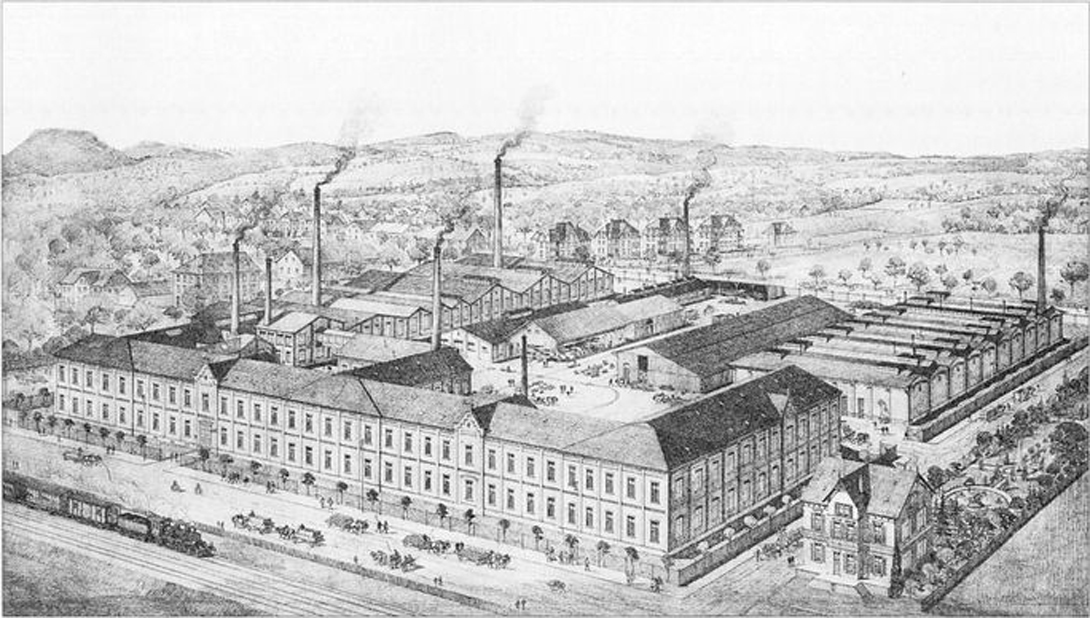
Illustration: Metallwarenfabrik Zug, Autumn 1909 (Source: INSA: *nventory of Modern Swiss Architecture, 1850–1920: Cities, Volume 10)
Through the railway, industry, and hospitality sector, commercial activity increasingly shifted to the city, counteracting the "great emptiness of people and lack of business," and in the "silent and motionless Zug," one now suddenly perceived, also due to the almost simultaneous appearance of the first automobiles, an acoustic entry into the industrial era—an era generally characterised by an overlay of multiple sounds.
Of course, this does not mean that the city and its immediate surroundings had previously been completely silent (silence is always relative, and absolute silence is something we will never "hear" on Earth). However, most activities were confined to the daytime—due to the closure of city gates (until 1835), curfews, and the lack of lighting. Most work, as Carl Julius Lange described, took place in the fields. Since this labor was largely manual—meaning it long remained free of machines—and since farmsteads were widely spaced across open fields, work was carried out at a "human pace," preventing sounds from overlapping.
Simplified to its essentials, typical sounds included the clattering of horse hooves on cobblestone streets or the barking of dogs. The dominant "leitmotifs" were likely church bells. All audible sounds, near and far, must have been relatively easy to distinguish and hear in parallel, even within the city walls. However, after industrialisation, everyday life accelerated, and with machines, factories, railways, and auto mobiles, new, louder sounds were introduced.
What were once distinct and separable sound events gradually merged into overlapping, continuous soundscapes—a kind of background noise, which would later be further amplified by electricity. This noise also contained subtle, continuous sounds, such as the hissing of gas lamps or, later, the 50Hz hum (60Hz in America) of alternating current, a sound we generally no longer consciously perceive in everyday life.
The first "true" sound recording dates back to 1860 and was made using a so-called phonautograph, a device that could record sound but not play it back. However, in the digital age, this graphical recording can now be converted into sound:
The invention of the first sound recording device capable of playback is credited to Edison and dates back
to 1877.
The first recordings made using "modern methods" (electromagnetic recording) date back to 1898, while the first usable tape recordings emerged around 1940. Additionally, a microphone—unlike, for example, an aerial photograph—captures only a very small radius and does not represent it directly but rather amplifies it in a way. It functions more like a light in the darkness that illuminates only a small area or like a magnifying glass that focuses on a single section.
To determine how the soundscape of the past might have sounded, I must rely on written accounts from contemporaries such as Carl Julius Lange. However, many references to sounds or noise are often rather subtle or vaguely described and must therefore be interpreted with caution—such as in the newspaper report on the opening of the Zug – Goldau railway line from June 1897:
„Opening of the Northern Access Lines to the Gotthard
After the dreary rainy days that heralded the past week, the heavens shone forth yesterday, Sunday, in splendid festive weather—almost as if the dear Lord Himself wished not to spoil the occasion for those regions that had long and eagerly awaited the opening of improved routes of commerce. It was as if He sought once more to prove to His impatient children the truth of the old adage: "All's well that ends well!"
No wonder, then, that the clear and beautiful festive sky reflected itself upon the joyful faces of young and old among the people of Zug, who, in great numbers from the morning onward, thronged the richly and tastefully decorated streets and squares of the capital.
At one o’clock, the members of the city council and committees, accompanied by the rousing strains of a lively festival march performed by the valiant city band, and with a detachment of the fire brigade, made their way to the new railway station to welcome the festive train arriving from Goldau.
Here, the diligent festival committee was already busily engaged in its noble duty, having thoughtfully enlisted the aid of a few blooming youths—students of the cantonal school—who served the honoured guests with silver goblets of celebratory wine or a hearty tankard of fresh beer. We had to wait a little while longer until our Donnergott (god of thunder) could announce, with a first cannon shot, the arrival of the train as it entered the city tunnel.
At last, it came!—with splendid new luxury carriages, such as could only be found on this grand international Gotthard Railway. The city band struck up its festive airs, and greetings, handshakes, and toasts were exchanged between the merry guests and the representatives of the Canton and City of Zug. A lovely assembly of ladies had also joined the official gentlemen, and even the white-clad and elegantly adorned honorary ladies from Meggen, Küssnacht, Arth-Goldau, and Walchwil were not absent. Hats off, this time, to the Walchwil ladies! The Walchwiler-Meiteli (girls of Walchwil) were the fairest of them all! They so charmed the people of Zug that official caps went flying left and right, and even the serious magistrates and dignified committee members reached for the silver goblets proffered by their charming neighbours from Walchwil.
Yet the jubilation at the Zug railway station was not to last long. Within minutes, the signal for departure was sounded. Amidst the strains of music, the thunder of cannons, and the cheerful farewells of the gathered crowds, the guests—joined now by representatives of the Zug authorities—headed southward once more.
"Station Oberwil!" called a voice. A proper station, indeed! Even the personnel were present, and the bells rang—but alas, the train did not stop! "It would have been too lovely—it was not meant to be!" Yet the jest was well received, and at the very least, the esteemed directors and board members of the Gotthard Railway now knew the precise spot where, one day, a station in Oberwil might properly be placed—should this locality, in keeping with the times, develop to the point where stopping there would be worthwhile. Patience! It will come in time. Now we are situated along an international route of travel, and soon Zug and its suburb Oberwil shall grow together. Then, we shall revisit the matter.
"Onward we went through field and hedge," along the route, which, from this point forward, unfolded in all its splendour—climbing the steep mountain slopes and traversing magnificent feats of engineering. To the left, the green forested heights; to the right, below us, the deep blue Zugersee, whose idyllic shores greeted us especially sweetly and kindly this day. Before us stood the proud guardians of this pastoral scene—Rigi and Pilatus—and between them, crowned with snow and ice, the Bernese Alps: Jungfrau, Eiger, Mönch, and their royal brethren.
Truly! A wondrously beautiful piece of God’s nature and Swiss grandeur, such as can be seen only along this incomparable route and which—of this we are certain—shall in future delight thousands of tourists and lovers of nature.
But hold! Even as I am in the full stride of my festive report, our prompt artillery captain once again fires his "Boom!" to remind me that the opening celebrations continue today. Yes, yes—I am coming! Quickly, into my festive attire! The continuation shall follow in the next edition!“
The references are very sparse, and the quality of the auditory information is quite low. However, since I find the report highly readable and historically informative—and because I could not help but smile several times while reading it—I have decided to reproduce it in its entirety.
The playing city band, which still exists today, is familiar to us (at the inauguration of the new station in Zug in 2003, only the hired musicians and the stylistic content had changed). We also still recognise the "Donnergott" and the "Boom!" of celebratory or ceremonial cannon fire, though not to the same extent as in the past.
However, I noticed that in Oberwil, "bells were rung," though from the context, it is not entirely clear whether the ringing came from the train itself or from the "Oberwil staff." In any case, there was bell ringing, meaning a bell was used.
Today, the bells of locomotives have been replaced by horns, known as "Makrofone" (train horns), while station bells have been replaced by electronic acoustic signals (though the SBB/CFF/FFS sound logo now merely serves as an alert for an upcoming announcement). Their functions have also changed in part. Whereas acoustic signals in the past conveyed different types of information depending on their use—between railway workers, trains, track workers, and passengers—today, they serve solely as warnings. Due to tighter schedules and technological advancements, they have been replaced by track side telephones and visual (light) signals.
2014: I made sound recordings in and around Zug station. Beforehand, I would like to briefly point out that:
- It is advisable to listen to all sound recordings in my contributions with headphones whenever possible, as spatial and auditory details can be perceived much more precisely and meaningfully this way.
- All recordings were made on weekdays within the narrow time frame between approximately 14:00 and 15:30 and have a length of around 5 minutes (start and end points were chosen randomly, with no cuts in between).
- The recordings are presented in an unedited form (no dynamic or frequency processing).
- The volume levels of the recordings are all relative to one another, allowing for direct comparison, but no statement can be made about the actual sound pressure level.
Audio recording: station square
In my imagination, train stations in cities always have something hectic about them. When I positioned myself to the right of the drinking fountain, facing the main entrance of the train station, and took these recordings, I was surprised by how quiet it was here. Of all the recordings I’ve made in public spaces in the city of Zug, these are among the calmest.
It's worth mentioning the significant change in sound depending on the distance of the sound source from the recording location. The “gurgling” of the drinking fountain on the left is a good reference. It's quite easy to localise and sounds very bright and clear. The car door 0:06 sounds a bit more muffled. Clearly, one can hear (especially with headphones) an echo from the right, a sign that we are in an “enclosed” space. Voices nearby are fairly easy to decipher, while, as the distance increases, they quickly blend into the background noise. I find the sound progression from about 2:25 to 2:50 very nice. The sharp “clicking” of the stilettos gives us wonderful information about the acoustics of the station square. Since these are very short sounds, you can clearly hear the reverberation. There is a brief moment, around 2:34 to 2:36, when the echo seems less dominant, and the clicking is heard more directly and closely.
In acoustics, we speak of direct sound and diffuse sound. Direct sound refers to sound sources that reach the ear first, without first being reflected by a wall, floor, or ceiling. In other words, the sound sources that travel directly (through the air) from the sound source (the stilettos) to my ear, while diffuse sound refers to all sound sources that reach me via a detour, such as the asphalted ground. Direct sound is important for localisation or speech intelligibility, while diffuse sound gives information about the room's characteristics and size.
The dominance of the echo with the car door, stilettos, and speech suggests a highly reflective acoustic environment. The station square is actually surrounded by buildings on almost all sides (both sides of the Alpenstrasse and the train station facade), which reflect the sound. At the same time, since the 2003 renovation, it has become a kind of arena-like basin, so the sound is reflected from all sides. Still, we don’t hear many overlapping sounds. Most sounds can be distinguished and recognised. The “walls” and the lowered position also provide sound insulation from noise from “outside.” The sound either travels over the basin or is blocked by the buildings. The previously mentioned “continuous sound mixture” is quiet in the background (the cars, the pneumatic drill, etc.).
But there are also other reasons for the quietness. In fact, I happened to catch exactly five minutes in which neither trains nor buses arrived, so there was little traffic noise, and not many people were around. I also noticed that most of the people passing through no longer use the route over the station square and the main entrance but instead cross the station along the East-West axis.
Audio recording: Station Hall
The recording position is in front of the travel agency, facing the center of the hall. This recording is also generally quite quiet, but in contrast to the station square, it is more chaotic.
You immediately hear the typical sound characteristics of a large hall: a lot of echo and reverb. Due to the businesses, more people, and especially because it is an indoor space, there are far more sound overlaps than in front of the station. The many voices form a continuous sound carpet, with only fragments of speech being intelligible from close proximity. Short mechanical sounds or noises from the restaurants also weave into this carpet. Rarely, individual discrete sounds stand out, such as the coins from the ticket machine 1:44, the rattling 4:20, or the opening of a soda can 5:25. The spatial localisation of the sound sources is almost impossible.
Despite the many acoustic events, the train station hall does not give me a hectic impression, probably due to the almost monotonous continuity. What stands out in the recording is the constant noise at a consistent pitch, which is especially noticeable in the background on the right channel. It sounds a bit like a vacuum cleaner. In the context of the station, I can’t really place it. Could it be ventilation? I wonder if it is always audible at the Zug station?
CL, 20.10.2014 in «Ansichten von Zug», a blog of the «forum junge kunst»